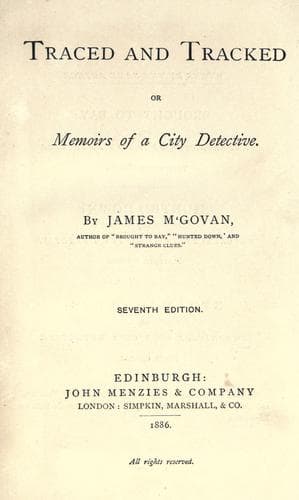
Traced and Tracked; Or, Memoirs of a City DetectiveM'Govan, James
General
Traced and Tracked; Or, Memoirs of a City Detective
M'Govan, James
Detective and mystery stories; Edinburgh (Scotland) -- Fiction
“A light box. I think he said it was to be kept dry, as there were
artificial flowers and ribbons in it. Ah, here is the entry—it is
not paid you see—he said we’d take greater care of it if it wasn’t
prepaid—‘Sent by James Paterson, to Robert Marshall, Linlithgow. To
lie at station till called for.’”
“Was the box big enough to have held a fiddle?”
“About that size, sir. I don’t think it would have held the
fiddlestick too. The fiddlestick is longer, and would take more room.”
“Was the box called for at the other end, do you know?” I asked,
beginning to be more hopeful.
“I don’t know about that—it was sent away, and that’s all we have to
do with it. These parcels are generally expected, and don’t lie long
unclaimed.”
“You’ve got a telegraph handy—would you just send a message through,
particularly asking if that box has been called for?” and I calmly
sat down and motioned the clerk to his place at the instrument; and
in a short time had the welcome news that the “box was there still,
and had not been asked for.”
I looked at my watch and then consulted a time-table, and found that
if I drove smartly into Edinburgh I could easily get a fast train
to Linlithgow, without waiting for the slow connection with this
out-of-the-way branch line. Afraid of looking foolish if I found
myself mistaken, I dropped my companion at Edinburgh and took train
for Linlithgow alone. The moment I got out, and the bustle of the
train’s arrival and departure was over, I got the booking-clerk to
turn out his parcel press, and easily found the box I was in search
of. It was but roughly put together, and appeared to have been made
out of the undressed spars of an old orange box; but by shaking it
sharply I soon ascertained that it contained something harder than
either flowers or ribbons. After a consultation, I was allowed to use
a chisel to the lid, and easily prised it up sufficiently to pull
out the paper and straw with which it was padded, and found snugly
reposing underneath, a fiddle which in every respect answered the
description of that stolen from Mr Cleffton.
I had little doubt that I had fairly recovered the stolen property,
but I was just as anxious to get hold of the thief. It appeared to
me that the sending of the fiddle by rail to this quiet station was
merely the adoption of a safe hiding-place till the hue and cry of
the robbery were over, and that as soon as the actual instigator felt
safe he would appear to claim the box. I could not afford to wait so
long; so I got permission to fasten up the box and leave it, while I
returned to Edinburgh bearing the fiddle.
My first visit was to the gentleman who had introduced me to Mr
Turner, and he identified the fiddle at a glance as Cleffton’s; but
he did more. Getting out a fiddle bow, he ran his fingers over the
strings in a testing way, and at last said decidedly—
“I could stake my life on it that that’s M——’s £50 Cremona that was
stolen as I told you. Suppose we go along to his house and see?”
Public-domain text, read in full here on John Shaqi.
Reviews
Reviews
No reviews yet
Be the first to share your thoughts on this work.
Elsewhere in the archive
Join the Discussion
Join the discussion
Sign in to leave a comment or review.
Sign InorCreate an account