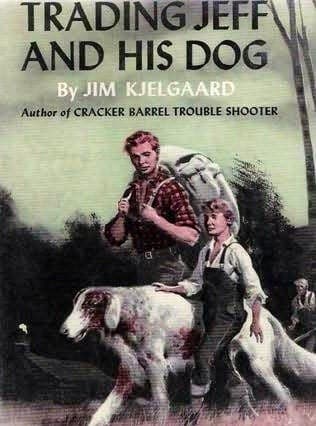
The dog tried to follow, but though he could run very fast, he could not
keep up with the car. Outdistanced, he panted back to the cabin because
he was sure that Johnny would return there, too. He waited a week, never
venturing far away and eating only what he could find or catch. Then he
set out to look for Johnny.
He'd gone first to Smithville and the first person he'd met there was
Pete Whitney. The dog slowed to a walk, watching Pete warily and
bristling. He saw no connection between any of Pete's actions and
Johnny's disappearance, but all the Whitneys were enemies. He leaped
aside when Pete aimed a swift kick at his groin, then turned with bared
fangs. Unarmed, Pete shrank back against a near-by building and the dog
went on.
The alarm was sounded; Johnny Blazer's dog had come into town and
threatened a person. For a while--Johnny had many friends in
Smithville--nothing was done. But after two days, the dog was considered
a menace. Mothers of small children became concerned for their safety.
The first act of most men, upon seeing the dog, was to pick up and hurl
any convenient missile.
The Smithville constable, Bill Ellis, reluctantly set out to kill the
animal. But two hours earlier, having satisfied himself that he would
not find Johnny in Smithville, the dog had left. What he could not
possibly know was that his master was dead and the official cause of his
death was, "Bullet wound inflicted by a person or persons unknown."
As the dog wandered, hope faded. He could not find Johnny. But the dog
had to have a master because he was unable to live without one, and now,
as he lay in the tall weeds, all the deep yearnings in his heart
concentrated on this man splitting wood.
He half rose, minded to walk out and meet him, but memory of the rocks
and clubs that had come his way was not an easy one to banish and he
settled down in the weeds again. Then an uncontrollable longing for
someone to love and someone to love him overcame everything else and he
left the weeds.
He walked with his tail drooping in a half circle down his rear, but he
was not abject because it was not in him to be so. One or more of his
many ancestors had bequeathed to him a great pride and a regal inner
sense, and though he would run when a club or brick was hurled at him,
he could never cringe. He carried his tail low because that was the way
he carried it naturally, like a collie or staghound.
The man, setting a chunk of wood against the splitting block, had his
back turned to the dog and did not at once see him. The dog waited,
unwilling to intrude until he was invited to do so. The man raised his
axe, brought it expertly down, and the wood split cleanly. He stooped to
pick up the two pieces and when he did he saw the dog.
"You!"
Public-domain text, read in full here on John Shaqi.
Reviews
Reviews
No reviews yet
Be the first to share your thoughts on this work.
Join the Discussion
Join the discussion
Sign in to leave a comment or review.
Sign InorCreate an account