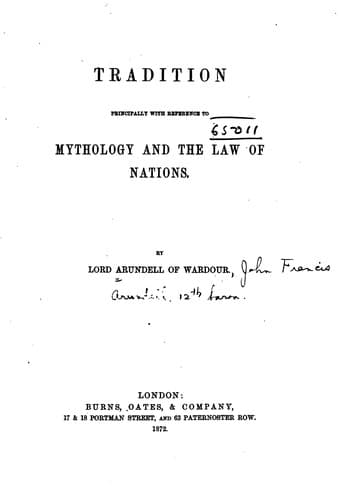
Tradition, Principally with Reference to Mythology and the Law of NationsArundell of Wardour, John Francis Arundell, Baron
Philosophy
Tradition, Principally with Reference to Mythology and the Law of Nations
Arundell of Wardour, John Francis Arundell, Baron
International law; Macdonell, George, 1780-1870; Mythology; Natural law; Tradition (Theology)
If the finger of God did not so rest, there is no assignable reason
why this pyramid--this incubus, as some would call it--which goes
back, stone upon stone, to the primitive ages, should not have been
overturned, and some system purely atheistical, purely material, purely
communistic, substituted for it. But I believe that no democratic
organisation, however extended among the masses, will overthrow the
established order of things, so long as the possessors of property,
the upper classes, are true to the objects for which property was
instituted.
Considering how much man has effected in the material order, and
considering also the varied intellectual faculties with which he is
endowed, it strikes one as strange, as something which has to be
accounted for, that he has been able to effect so little in the moral
order. It is the same whether we regard the action of the intellect
upon the individual man, or upon society. And from this latter point
of view it is so true, that it is more than doubtful whether those
epochs in which man has attained the highest point of intellectual and
material civilisation, are not those also in which he has reached the
lowest depths of immorality;[80] and in which--having touched the
lowest point of corruption--the human intellect is unable to devise
any better plan for the government of mankind, than the repression of
despotism.[81]
[80] "It is, upon the whole, extremely doubtful whether those
periods which are the richest in literature, possess the
greatest shares, either of moral excellence or of political
happiness. We are well aware that the true and happy ages of
Roman greatness long preceded that of Roman refinement and
Roman authors; and, I fear, there is but too much reason to
suppose that in the history of the modern nations we may find
many examples of the same kind" (F. Schlegel's "History of
Literature," i. 373). See also the account of the corruption
of morals in Rome in the Augustan period (Allies' "Form. of
Christendom," I. Lect. I.) "It is curious to observe that the
more eloquent, polite, and learned the Greeks became, in the
same proportion they became the more degraded and corrupt in
their national religion" (Godfrey Higgins' "Celtic Druids,"
1829, p. 207).
[81] "Il n'y a, Messieurs, que deux sortes de repression
possibles: l'une intérieure, l'autre extérieure.... Elles
sont de telle nature que quand le thermomètre politique est
élevé, le thermomètre de la religion est bas, et quand le
thermomètre religieux est bas, le thermomètre politique, la
repression politique, la tyrannie s'élève. Ceci est une loi
de l'humanité, une loi de l'histoire." _Vide_ Disc. de Donoso
Cortes (Marq. de Valdegamas), 4th January 1849; in which he
pursues this remarkable parallelism throughout history.
Public-domain text, read in full here on John Shaqi.
Reviews
Reviews
No reviews yet
Be the first to share your thoughts on this work.
Elsewhere in the archive
Join the Discussion
Join the discussion
Sign in to leave a comment or review.
Sign InorCreate an account