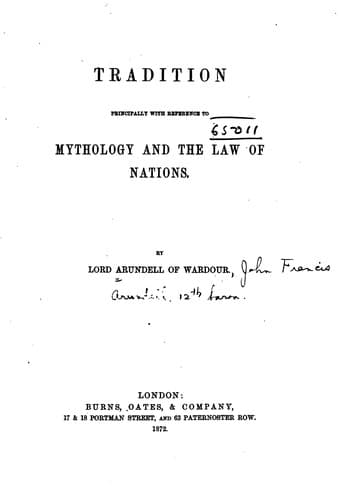
Tradition, Principally with Reference to Mythology and the Law of NationsArundell of Wardour, John Francis Arundell, Baron
Philosophy
Tradition, Principally with Reference to Mythology and the Law of Nations
Arundell of Wardour, John Francis Arundell, Baron
International law; Macdonell, George, 1780-1870; Mythology; Natural law; Tradition (Theology)
the abandonment of all kinds of religious discussion, as
matter of purely personal inclination, and the abolition of
all kinds of privileges as incompatible with equality." [All
this has been put out of date by the deeds of the Commune
and the programme of the "International Society"--viz. "_The
burning of Paris_ we _accept the responsibility of_. _The old
society must_ and will perish."] The _Spectator_, December
1869, speaks still more explicitly:--"Infirm and crippled
though she be, the Roman Church is still the only one who
has the courage to be cosmopolitan, and claim the right to
link nation with nation, and literature with literature. Such
an assembly as the Council is, at least, an extraordinary
testimony to the cosmopolitanism of the great Church
which seems trembling to its fall; and who can doubt that
that fall, whenever it comes, will be followed by a great
temporary loosening of the faith in human unity--in spite of
the electric telegraph--by a deepening of the chasm between
nation and nation, by the loss of at least a most potent
spell over the imagination of the world, by a contraction
of the spiritual ideal of every church? This ideal, even
Protestants, even Sceptics, even Positivists have owed, and
have owned that they owed, to the Roman Church, the only
Church which has really succeeded in uniting the bond between
any one ecclesiastical centre and the distant circumference
of human intelligence and energy. But if the consequence of
the collapse of Romanism would be in this way a loss of power
to the human race, think only of the gain of power which
would result from the final death of sacerdotal ideas, from
the final blow to the system of arbitrary authority exercised
over the intellect and the conscience, from the new life which
would flow into a faith and science resting on the steady
accumulation of moral and intellectual facts and the personal
life of the conscience in Christ--from the final triumph of
moral and intellectual order and freedom. It would doubtless
be a new life, subject to great anarchy at first; but the old
authoritative systems have themselves been of late little more
than anarchy just kept under by the authority of prescription
and tradition; and one can only hope for the new order from
the complete recognition that it is to have no arbitrary or
capricious foundation."
Here comes in, with its full significance, the great saying of
Lacordaire's--"Order I compare to a pyramid reaching from heaven to
earth. Men cannot overthrow its base, because the finger of God rests
upon its apex."
Public-domain text, read in full here on John Shaqi.
Reviews
Reviews
No reviews yet
Be the first to share your thoughts on this work.
Elsewhere in the archive
Join the Discussion
Join the discussion
Sign in to leave a comment or review.
Sign InorCreate an account