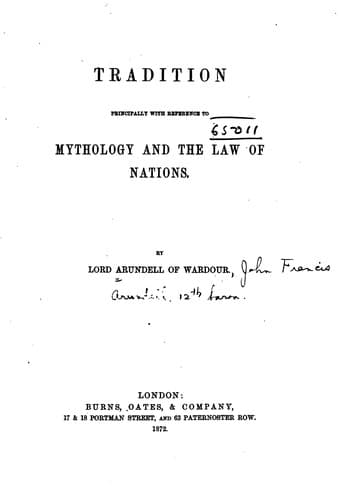
Tradition, Principally with Reference to Mythology and the Law of NationsArundell of Wardour, John Francis Arundell, Baron
Philosophy
Tradition, Principally with Reference to Mythology and the Law of Nations
Arundell of Wardour, John Francis Arundell, Baron
International law; Macdonell, George, 1780-1870; Mythology; Natural law; Tradition (Theology)
[82] Montalembert ("Disc. de Reception," 1852, Discours iii.
pp. 614, 615, 621, 622) says of the Constituent Assembly
of 1789--"It was the Assembly of 1789 which made the word
revolution the synonyme of methodical destruction, of
permanent war against all order and all authority.... It had
that mania for uniformity which is the parody of unity, and
which Montesquieu called the passion of mediocre minds....
In a word, the Constituent Assembly was wanting not only in
justice, courage, and humanity, but it was also deficient in
good sense. The evil which it created has survived it. It has
made us believe that it is possible to destroy everything
and to reconstruct everything in a day.... God has chastised
it, above all, by the sterility of its work. It had had the
pretence of laying the foundations of liberty for ever, and
it had for its successors the most sanguinary tyrants who
ever dishonoured any nation. Its mission was to re-establish
the finances, the empire of the law, and it has bequeathed
to France bankruptcy, anarchy, and despotism--despotism
without even the repose which they have wrongly taken as the
compensation of servitude. It has done more: it has left
pretexts for every abuse of force, and precedents for any
excess of future anarchy. [Montalembert could hardly have
foreseen the last application of its principles which we
have recently witnessed in Paris by the Commune, which, too,
forsooth, was to have inaugurated a new era for humanity.] But
it (this Constituent Assembly) founded nothing--Nothing! The
ancient society which it reversed had lasted, in spite of its
abuses, a thousand years."
Can any one adduce a more typical representative of the clear,
powerful, penetrating intellect of man than Voltaire! Voltaire,
moreover, had the aim and ambition ("ecraser l'infame") to obliterate
the tradition of the past; yet can there be a better example of
the impotence of the intellect in the moral order? Does it not seem
startling that, when the human intellect, as in the case of Voltaire,
should be able to detect with so much acumen, so much wit, what is
wrong, that it should be wholly struck with sterility when it attempts
to tell us what is right, to reveal to man any truth in the moral order
not traditionally known to them. And if the disciples of Voltaire have
occasionally, in spasmodic efforts, attempted this, it has not been in
the manner of Voltaire; it has been in the spirit of eclecticism, of
reconstruction out of the elements of the past--that is to say (with
pardon, if the phrase has been used before), an attempt to create, out
of the elements he would have spurned, edifices which he would have
derided.
Public-domain text, read in full here on John Shaqi.
Reviews
Reviews
No reviews yet
Be the first to share your thoughts on this work.
Elsewhere in the archive
Join the Discussion
Join the discussion
Sign in to leave a comment or review.
Sign InorCreate an account