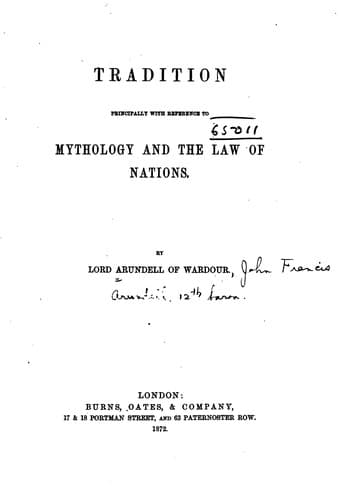
Tradition, Principally with Reference to Mythology and the Law of NationsArundell of Wardour, John Francis Arundell, Baron
Philosophy
Tradition, Principally with Reference to Mythology and the Law of Nations
Arundell of Wardour, John Francis Arundell, Baron
International law; Macdonell, George, 1780-1870; Mythology; Natural law; Tradition (Theology)
Now, the pretension of the human intellect is quite contrary to this
experience. It claims to have progressively elevated mankind out of
a state of primitive barbarism, to have indoctrinated them with the
ideas of morality which they possess, to have humanised them, and thus
affirms the converse of the theory of tradition which it pursues with
much unreasoning and implacable animosity.
The _Saturday Review_ (July 24, 1869), in reviewing Mr Gladstone's
"Juventus Mundi," says--"Mr Gladstone is doubtless well aware that
there was no portion of his Homeric studies which was received with
more surprise, or with more unfavourable comment, than his speculations
on what he described as the traditive and the inventive elements in
the Homeric mythology."[83] In consequence, Mr Gladstone says he has
endeavoured to avoid in his more recent work "a certain crudity of
expression." The _Saturday Review_, however, says--"That 'the crudity
of expression' here referred to seems to have been corrected and
modified to some extent by disguising the process of argument by which
it was sustained, and by the adoption of a lighter touch and slighter
treatment of the subject than in the former book. But the theory
itself, we believe, remains the same."
[83] From a purely philosophical point of view, why should these
speculations of Mr Gladstone have been received "with more
surprise and unfavourable comment" than any other "portions of
his Homeric studies?"
I may assume, then, that the passage which I have elsewhere quoted
from Mr Gladstone, and laid as the basis of my argument, still has
his countenance and support, in spite of the manifest antagonism it
has provoked. And this passage, I venture to think, acquires fresh
light and an accession of force when placed in juxtaposition with the
parallel passages from De Maistre and Dr Newman. These passages will
present no difficulties to the believer in the Bible. How far the
view is sustainable, with reference to the more recent conclusions in
chronology, I shall consider in another chapter; but, assuming that it
is not chronologically disproved, there is no intrinsic impossibility
which will debar belief.
The general probability of tradition being thus avouched,[84] I proceed
to examine certain statements that have been made as to its necessary
variability, and as to the uncertainty and indefiniteness of its
utterances.
[84] In one way, nothing is so uncertain as tradition, and,
moreover, tradition is rarely positive and direct, but, on the
contrary, prone to concrete into strange, fragmentary, and
distorted shapes. As an instance, we may take the tradition
which Genesis attests,--When Abraham's hand had been stayed by
the angel from the sacrifice of Isaac, ... "He called the name
of that place 'The Lord seeth.' Whereupon, even to this day it
is said, '_In the mountain the Lord will see_.'"--_Gen._ xxii.
14.
Public-domain text, read in full here on John Shaqi.
Reviews
Reviews
No reviews yet
Be the first to share your thoughts on this work.
Elsewhere in the archive
Join the Discussion
Join the discussion
Sign in to leave a comment or review.
Sign InorCreate an account