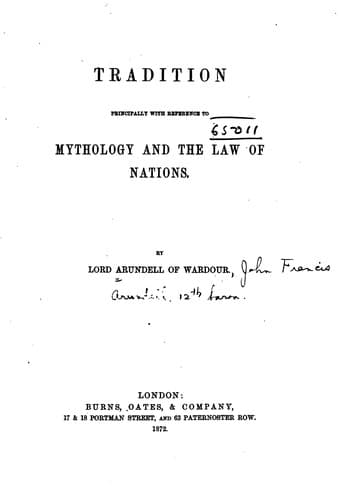
Tradition, Principally with Reference to Mythology and the Law of NationsArundell of Wardour, John Francis Arundell, Baron
Philosophy
Tradition, Principally with Reference to Mythology and the Law of Nations
Arundell of Wardour, John Francis Arundell, Baron
International law; Macdonell, George, 1780-1870; Mythology; Natural law; Tradition (Theology)
In illustration of the mode and manner of tradition, is the
anecdote of Mr Hookham Frere, who states, that when the
Maltese talk without reserve upon religious subjects, they
say, "Everybody knows that Adam was the first man, but we
alone know that he possessed fishing-boats;" which Bunsen says
"Can be nothing but a Phoenician reminiscence."--"Egypt,"
iv. 215, the reminiscence of the legend of the Fisherman.
Compare the Fisherman and his wife in Grimm's "Popular Stories
from Oral Tradition."
In the first place, as to its variability, it is true that tested by
the experience which we possess of the persistency and exactness of
family and local traditions, tradition in the broader sense which I
have indicated may appear to be of little value. I have elsewhere
attended a closer argument on this point in reply to Sir John Lubbock
(ch. xii.), but I may also make what appears to me, as regards this
matter, a sufficiently important distinction.
Family tradition is so confused, because at each remove in each
generation, it is necessarily crossed through marriage with
the traditions of another family. These may be either rival or
irreconcileable. But this remark will apply with much less force,
it will only secondarily and accidentally apply at all to the
common traditions, the inheritance of all families starting from a
common origin. If these traditions acquired some dross through the
intermarriage of families, they will, on the other hand, through the
very action of intermarriages, have been more frequently compared,
more vividly, therefore, kept in remembrance, and more recognisable
in their distortion, because the distortion is more likely to have
been in the way of super-addition of what was thought congruous and
supplemental. And this seems to me to meet Mr Max Müller's objection in
the _Contemporary Review_ for April 1870. "Comparative philology," he
says, "has taught again and again, that when we find _exactly_ the same
name in Greek and Sanscrit, we may be certain that it cannot be the
same word;" for we here see reason why and how these traditions have
been specially protected against the natural action and law which it is
the peculiar province of philology to trace.
Public-domain text, read in full here on John Shaqi.
Reviews
Reviews
No reviews yet
Be the first to share your thoughts on this work.
Elsewhere in the archive
Join the Discussion
Join the discussion
Sign in to leave a comment or review.
Sign InorCreate an account