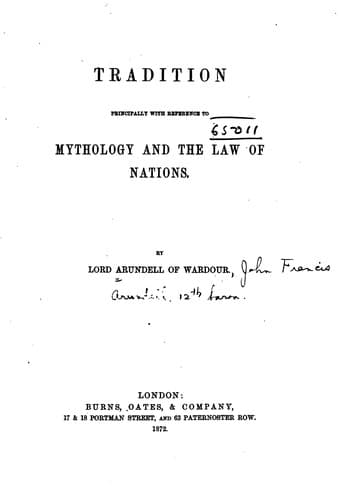
Tradition, Principally with Reference to Mythology and the Law of NationsArundell of Wardour, John Francis Arundell, Baron
Philosophy
Tradition, Principally with Reference to Mythology and the Law of Nations
Arundell of Wardour, John Francis Arundell, Baron
International law; Macdonell, George, 1780-1870; Mythology; Natural law; Tradition (Theology)
It is much too readily assumed that traditions must be worthless where
no records are kept. Gibbon,[92] I think, was the first who took
this position. To this I reply, that although records are valuable
for the attestation, they are not guarantees for the fidelity of
tradition.[93] I do not assert that the tradition is more trustworthy
than the record; but that, when mankind trust mainly to tradition, the
faculties by which it is sustained will be more strongly developed, and
the adaptation of society for its transmission more exactly conformed.
In other words, tradition in ancient times seemed to flow as from a
fountain-head, and the world was everywhere grooved for its reception.
We may take in evidence the strange resemblances in mythological
tradition in various parts of the world on the one hand, and on the
other the oral tradition of the Homeric verses; the frequent concourse
of citizens, and at recurring festivals of the surrounding populations,
to listen to their recital. And not only was there oral tradition in
verse, but all public events were recorded in the attestations of the
market-place. When a treaty was ratified it was commonly before some
temple, or in some place of public resort, and its terms were committed
to memory by some hundred witnesses; and in like manner was the
recollection of other public events and memorable facts preserved.[94]
(_Vide_ Pastoret's "Hist. de la Législation," i. 71; also, account of
"Annales Maximi" in Dyer's "Rome," xvii.)
[92] Gibbon ("Decline and Fall," i. 353) says, "But all this
well-laboured system of German antiquities is annihilated
by a single fact, too well attested to admit of any doubt,
and of too decisive a nature to leave room for any reply.
The Germans, in the days of Tacitus, were unacquainted with
the use of letters, and the use of letters is the principal
circumstance which distinguishes a civilised people from a
herd of savages, incapable of knowledge or reflection. Without
that artificial help, the human memory ever dissipates or
corrupts the ideas intrusted to her charge." Compare with
Coleridge, _infra_, p. 122; Ozanam, _infra_, ch. xiii.
[93] Eusebius ("Ecclesiastical Hist.," ch. xxxvi.) says, speaking
of St Ignatius--"He exhorted them to adhere firmly to the
tradition of the apostles; which, for the sake of greater
security, he deemed it necessary to attest by committing it
to writing." I do not remember to have seen this quoted in
testimony and proof of ecclesiastical tradition.
Public-domain text, read in full here on John Shaqi.
Reviews
Reviews
No reviews yet
Be the first to share your thoughts on this work.
Elsewhere in the archive
Join the Discussion
Join the discussion
Sign in to leave a comment or review.
Sign InorCreate an account