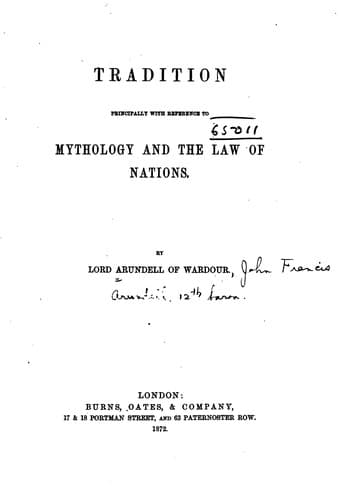
Tradition, Principally with Reference to Mythology and the Law of NationsArundell of Wardour, John Francis Arundell, Baron
Philosophy
Tradition, Principally with Reference to Mythology and the Law of Nations
Arundell of Wardour, John Francis Arundell, Baron
International law; Macdonell, George, 1780-1870; Mythology; Natural law; Tradition (Theology)
[94] Goguet ("Origin of Laws," i. 29) says--"The _first laws_
of all nations were composed in verse, and sung. Apollo,
according to a very ancient tradition, was one of the first
legislators. The same tradition says that he published his
laws to the sound of his lyre; that is to say, that he had
set them to music. We have certain proof that the first
laws of Greece were a kind of song. The laws of the ancient
inhabitants of Spain were verses, which they sung. Tuiston was
regarded by the Germans as their first lawgiver. They said he
put his laws into verses and songs. This ancient custom was
long kept up by several nations."
E. Warburton ("Conquest of Canada," i. 214) says--"The want
of any written or hieroglyphic records of the past among the
Northern Indians was to some extent supplied by the accurate
memories of their old men; they were able to repeat speeches
of four or five hours' duration, and delivered many years
before, without error, or even hesitation; and to hand them
down from generation to generation with equal accuracy.... On
great and solemn occasions belts of wampum were used as aids
to recollection ... when a treaty or compact was negotiated."
Yet, although during long periods oral transmission was for mankind
the main channel of tradition, it must not necessarily be concluded
that writing was unknown, and was not employed for monumental and
other purposes. What strikes one most forcibly in contemplating these
ages, is the contrast between their intellectual knowledge and their
mechanical and material contrivances for its application. During these
centuries in which the 30,000 hexameters of the "Iliad" and "Odyssey"
were transmitted in memory, by repetition, at public festivals, oral
tradition was doubtless employed, because during this period "paper,
parchment, or even the smoothed hides, as adapted for the purposes of
writing, were unknown."[95] This, whilst it certainly is in evidence of
the paucity of their available resources, at the same time establishes
the retentive strength of their memory,[96] and their intellectual
familiarity with great truths.
Public-domain text, read in full here on John Shaqi.
Reviews
Reviews
No reviews yet
Be the first to share your thoughts on this work.
Elsewhere in the archive
Join the Discussion
Join the discussion
Sign in to leave a comment or review.
Sign InorCreate an account