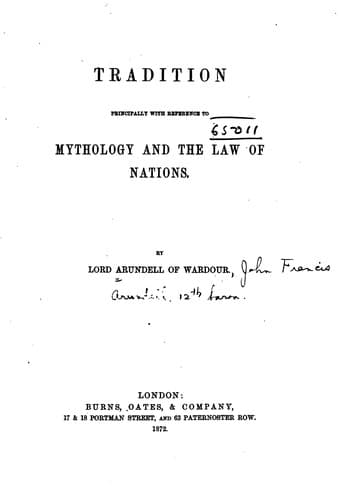
Tradition, Principally with Reference to Mythology and the Law of NationsArundell of Wardour, John Francis Arundell, Baron
Philosophy
Tradition, Principally with Reference to Mythology and the Law of Nations
Arundell of Wardour, John Francis Arundell, Baron
International law; Macdonell, George, 1780-1870; Mythology; Natural law; Tradition (Theology)
There is a further point which Mr Baring Gould must settle. Religion
may be theoretically regarded as an affair of growth, progressive,
or as an affair of revelation, or something so nearly counterfeiting
revelation as to arise spontaneously; but it cannot well be both. Now,
in the pages of Mr Baring Gould it appears at one time "springing
into life" (p. 109), and, as in the passage above, analogously to a
conception in the mind:--"_At first_ it is full of vigour, constantly
on the alert to win converts;" at another, "as a conception slowly
evolved;" then all at once "a living belief, vividly luminous"
(p. 109). Again (p. 110), "Religion does not reach perfection of
development at a bound; generations pass away, before," &c.; and (p.
329) we find that in all _primitive_ religions the idea of God is the
idea of a _devil_, or (_id._) "that the first stage in the conception
of a devil is the attribution of evil to God," which is different,
inasmuch as it supposes man to start with the knowledge of God, and is,
moreover, inconsistent with what is said at page 113:--"The shapeless
religion of a primitive people gradually assumes a definite form. It
is that of _nature_ worship. It progresses through polytheism and
idolatry, and emerges into monotheism or pantheism." Of course this
is said upon _the assumption_ that the primitive man was barbarous.
But however remote from the fact, it is theoretically as conceivable
that man should worship nature as an ideal of beauty and power, as
that he should regard it from the first as an apparition of terror;
or, in other words, that taking nature-worship for granted, Mr Max
Müller's view of it, viz.:--"He begins to lift up his eyes, he stares
at the tent of heaven, and asks who supports it? He opens his eyes
to the winds, and asks them whence and whither? He is awakened from
darkness and slumber by the light of the sun, and Him whom his eyes
cannot behold, and who seems to grant him the daily pittance of his
existence, he calls 'his life, his breath, his brilliant Lord and
Protector'" (Chips, i. 69, _apud_ B. G., 139),--is as likely to be
the true one as Mr Baring Gould's,[120] viz.:--"At first man is ...
antitheist; but presently he feels resistances.... The convulsions
of nature, the storm, the thunder, the exploding volcano, the raging
seas, fill him with a sense of there being a power superior to his
own, before which he must bow. His religious thought, vague and
undetermined, is roused by the opposition of nature to his will" (p.
137).
[120] _Vide_, however, Dr Newman's "Grammar of Assent," p. 386, _et
seq._
Public-domain text, read in full here on John Shaqi.
Reviews
Reviews
No reviews yet
Be the first to share your thoughts on this work.
Elsewhere in the archive
Join the Discussion
Join the discussion
Sign in to leave a comment or review.
Sign InorCreate an account