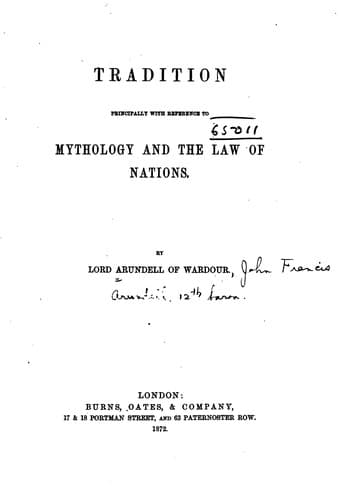
Tradition, Principally with Reference to Mythology and the Law of NationsArundell of Wardour, John Francis Arundell, Baron
Philosophy
Tradition, Principally with Reference to Mythology and the Law of Nations
Arundell of Wardour, John Francis Arundell, Baron
International law; Macdonell, George, 1780-1870; Mythology; Natural law; Tradition (Theology)
What follows seems to assume that some individual, or some set of
individuals, at a period more or less remote, evolved the idea of
God and religion out of their own consciousness; but that, as the
descendants of these individuals had not the same intellectual vigour,
the conception lapsed,--"their doctrines became hieroglyphs of which
they had lost the key." Nothing can be more conformable to the theory
of tradition;[119] but from the point of view of Mr Baring Gould,
what was to forbid other individuals broaching fresh conceptions? Is
there, however, any instance known to us? Is there any instance of a
religion not eclectic or pantheistic (the one being the mere revivalism
or reconstruction of the elements of former beliefs, and the other
their absorption), any religion "based on an intelligible principle,"
heretofore unknown to mankind, rising up and obtaining even a temporary
ascendancy among mankind? No; mankind, even in the darkness of
Paganism, persistently distinguished between religion and philosophy,
priests and sophists--though intellectually so much alike--and this
I consider to be a master-key to the history of the past (_ante_, p.
109).
[119] The most favourable review of Mr B. Gould's work which I
have seen says:--"In tracing the origin and development
of religious belief, the object of Mr Baring Gould is to
establish the foundation of _Christian_ doctrine on the
nature, the intuitions, and the reason of man, _rather than
upon traditionary dogmas_, historical documents, or written
inspirations. He is of opinion that the elements of true
religion are to be found in a revelation naturally impressed
upon the soul of man, and that the investigation of man's
moral nature will be found to disclose the surest proofs of
his religious wants and destination. The author holds that
if theological doctrines can be inculcated by demonstrative
evidence of their harmony with man's intellectual and moral
constitution, they will be received with more perfect
acquiescence and conviction than when appeals are made simply
to man's veneration for antiquity and authority." I think I
am, at any rate, right in taking Mr B. G.'s as the view most
directly opposed to tradition, and it is from this point of
view that I am brought into collision with him.
Public-domain text, read in full here on John Shaqi.
Reviews
Reviews
No reviews yet
Be the first to share your thoughts on this work.
Elsewhere in the archive
Join the Discussion
Join the discussion
Sign in to leave a comment or review.
Sign InorCreate an account