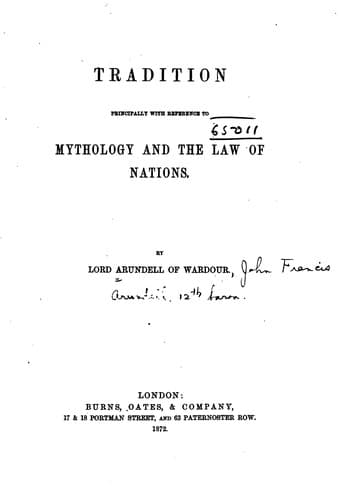
Tradition, Principally with Reference to Mythology and the Law of NationsArundell of Wardour, John Francis Arundell, Baron
Philosophy
Tradition, Principally with Reference to Mythology and the Law of Nations
Arundell of Wardour, John Francis Arundell, Baron
International law; Macdonell, George, 1780-1870; Mythology; Natural law; Tradition (Theology)
Therefore, Mr Baring Gould truly says--"Philosophy alone is not
religion." Philosophy, as we have seen, may prove the existence of God.
But religion, from the commencement of the world, has conveyed the idea
that there is a particular mode in which God must be worshipped. Here
philosophy is entirely at fault. Mr Baring Gould again truly says that
"dogma, worship, and discipline are the constituents, so to speak, the
mind, spirit, and body of religion" (p. 119). But he goes no further,
and does not explain how it came about that mankind in all ages have
adhered with singular pertinacity to the notion that religion could
teach that on which philosophy must perforce be silent. Has not the
greater intellect ever been on the side of philosophy? Nay,[121] in the
epochs in which intellectual superiority was undeniably on the side of
philosophy, did the populace go to the academy or to the oracles? If
the human intellect had originally framed the ritualistic observances,
which bore so strange a resemblance in different parts of the world;
if human sagacity had originated the idea of sacrifice (and wherefore
sacrifice from the point of view of human sagacity?); if philosophy had
revealed to them the religious conceptions which they retained, and
had been able to define the relation of man to the Divinity--would not
mankind, in all ages, have had recourse to its greatest intellects for
the solution of its doubts, rather than to the guardians of an obscure
and corrupt tradition? The question no doubt is complicated with the
evidence as to demonolatry; but the extent to which this prevailed only
enforces the argument against Mr Baring Gould, to whom, apparently, the
demon (p. 135) is not a real existence, but only the embodiment of a
phase of thought, and must seriously embarrass those who attribute the
regeneration of man from savagery to intellectual growth and natural
progress.
[121]
"The lively Grecian, in a land of hills,
Rivers, and fertile plains, and sounding shores,
. . . . . . . . . . . . . . . . In despite
Of the gross fictions chanted in the streets
By wandering rhapsodists, and in contempt
Of doubt and bold denial hourly urged
Amid the wrangling schools, a Spirit hung,
Beautiful region! o'er thy towns and farms,
Statues and temples, and memorial tombs;
And emanations were perceived, and acts
Of immortality, in nature's course,
Exemplified by mysteries that were felt
As bonds, _on grave philosopher imposed_,
And armed warrior; and in every grove
A gay or pensive tenderness prevailed,
When piety more awful had relaxed."
--WORDSWORTH, _Excursion_, B. iv.
Public-domain text, read in full here on John Shaqi.
Reviews
Reviews
No reviews yet
Be the first to share your thoughts on this work.
Elsewhere in the archive
Join the Discussion
Join the discussion
Sign in to leave a comment or review.
Sign InorCreate an account