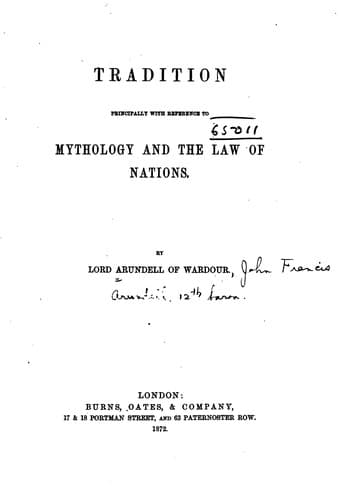
Tradition, Principally with Reference to Mythology and the Law of NationsArundell of Wardour, John Francis Arundell, Baron
Philosophy
Tradition, Principally with Reference to Mythology and the Law of Nations
Arundell of Wardour, John Francis Arundell, Baron
International law; Macdonell, George, 1780-1870; Mythology; Natural law; Tradition (Theology)
But demonology apart, what would have countervailed against the
superiority of reason and the intellectual prestige of the world except
a belief in a tradition of primitive revelation? What else will account
for the different recognitions of philosophy and religion--priests and
sophists? What else would have prevented mankind from resorting in
their difficulties to where the greatest intellect was found?
At page 134, this truth seems to gain partial recognition in the pages
of Mr Baring Gould:--
"In conclusion, it seems certain that for man's spiritual
well-being, these forces ('the tendency to crystallise, and the
tendency to dissolve') need co-ordination. Under an infallible
guide, regulating every moral and theological item of his spiritual
being, his mental faculties are given him that they may be
atrophied, like the eyes of the oyster, which, being useless in the
sludge of its bed, are re-absorbed. Under a perpetual modification
of religious belief, his convictions become weak and watery,
without force, and destitute of purpose. In the barren wilderness
of Sinai there are here and there green and pleasant oases. How
come they there? By basaltic dykes arresting the rapid drainage
which leaves the major part of that land bald and waste. So in the
region of religion, _revelations and theocratic systems have been
the dykes saving it_ from barrenness, and encouraging mental and
sentimental fertility" (p. 134).
It is impossible that we should quarrel with this illustration, it
is so exactly to our point. Is it not another way of affirming the
position which I maintain against Sir John Lubbock? (ch. xii.) May
not we, too, take our stand upon these "oases" of tradition, which
"revelations" and "theocratic systems" have formed, and ask what the
human intellect has been able to achieve for the spiritual cravings of
man in the waste around?
Mr Baring Gould, indeed, says (p. 61):--
"A power of free volition within or outside all matter in motion
was a rational solution to the problems of effects of which man
could not account himself the cause. Such is the origin of the
idea of God--of God _whether many_, inhabiting each brook and
plant, and breeze and planet, _or as_ being a world-soul, _or
as_ a supreme cause, the Creator and sustainer of the universe.
The common consent of mankind has been adduced as a proof of a
tradition of a revelation in past times; but the fact that most
races of men believe in one or more deities proves nothing more
than that all men have drawn the same inference from the same
premises. It is idle to speak of a 'Sensus Numinis' as existing as
a primary conviction in man, when the conception may be reduced to
more rudimentary ideas. The revelation is in man's being, in his
conviction of the truth of the principle of causation, and thus it
is a revelation made to every rational being."
Public-domain text, read in full here on John Shaqi.
Reviews
Reviews
No reviews yet
Be the first to share your thoughts on this work.
Elsewhere in the archive
Join the Discussion
Join the discussion
Sign in to leave a comment or review.
Sign InorCreate an account