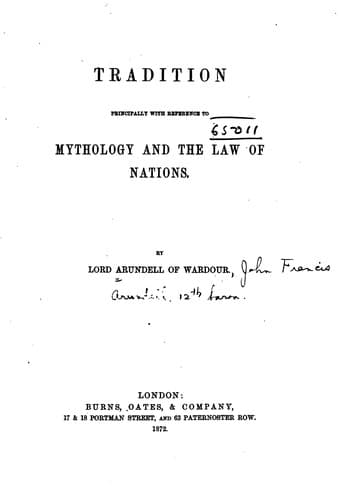
Tradition, Principally with Reference to Mythology and the Law of NationsArundell of Wardour, John Francis Arundell, Baron
Philosophy
Tradition, Principally with Reference to Mythology and the Law of Nations
Arundell of Wardour, John Francis Arundell, Baron
International law; Macdonell, George, 1780-1870; Mythology; Natural law; Tradition (Theology)
"It is the glory of the Semitic race to have given to the world, in
a compact and luminous form, that monotheism which the philosophers
of Greece and Rome only vaguely apprehended, and which has become
the heritage of the Christian and Mohammedan alike. Of the Semitic
race, however, one small branch, Jewdom, preserved and communicated
the idea. Every other branch of that race _sank into_ polytheism
(_vide supra_).... It is at first sight inexplicable that Jewish
monotheism, which was in time to exercise such a prodigious
influence over men's minds, should have so long remained the
peculiar property of an insignificant people. But every religious
idea has its season, and the thoughts of men have their avatars....
It was apparently necessary that mankind should be given full
scope for unfettered development, that they should feel in all
directions after God, if haply they might find Him, in _order that_
the foundations of _inductive philosophy might be laid_, that the
religious idea might run itself out through polytheistic channels
_for the development of art_. Certainly Jewish monotheism remained
in a state of congelation till the religious thought of antiquity
_had exhausted its own vitality_, and _had worked out every other
problem of theodicy_; then suddenly thawing, it poured over the
world its fertilising streams" (p. 259).[123]
[123] Mr B. Gould also says, p. 104--"The Semitic divine names
bear _indelibly on their front the stamp of their origin_,
and the language itself testifies against the insulation and
abstraction of these names from polytheism. The Aryan's tongue
bore no such testimony to him. The spirit of his language
_led him away from monotheism_, whilst that of the Shemite
was an ever-present monitor, directing him to a God, sole and
undivided. 'The glory of the Semitic race is this,' says M.
Renan, 'that from _its earliest days_ it grasped that notion
of the Deity which all other people have had to adopt from its
example, and on the faith of its declaration.'"
Public-domain text, read in full here on John Shaqi.
Reviews
Reviews
No reviews yet
Be the first to share your thoughts on this work.
Elsewhere in the archive
Join the Discussion
Join the discussion
Sign in to leave a comment or review.
Sign InorCreate an account