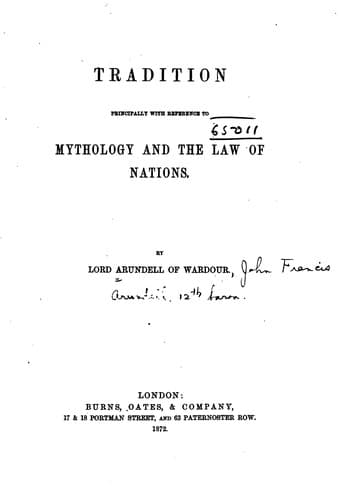
Tradition, Principally with Reference to Mythology and the Law of NationsArundell of Wardour, John Francis Arundell, Baron
Philosophy
Tradition, Principally with Reference to Mythology and the Law of Nations
Arundell of Wardour, John Francis Arundell, Baron
International law; Macdonell, George, 1780-1870; Mythology; Natural law; Tradition (Theology)
From all this it results that, so far as the testimony of the Semitic
race is concerned (which, by the by, a concurrence of tradition points
to as the oldest), the human race did not "emerge into monotheism," but
"sank into polytheism;" that monotheism was their belief from "their
earliest days," and their language bearing testimony to the same, shows
also that it was primitively so. It moreover results, that although
mankind may have been allowed to sink into polytheism, as a warning or
a chastisement, it certainly could not have been "in order that the
foundations of inductive philosophy might be laid;" for it is quite
apparent from this extract that the induction was _never made_ that man
did _not_ "emerge into monotheism;" but that having "_exhausted its
vitality_," and "worked out every problem of theodicy" in the way of
corruption, it _received_ monotheism back again from the only people
who had preserved it intact.
At any rate, monotheism came to it _ab extra_, and before polytheism
had attained the "full scope of that development" which was necessary
for the perfection of art!
But Mr Baring Gould having a perception that this admission (although
he has not apparently seen its full significance) is fatal to his
theory, hastens to unsay it at page 261, "Whence did the Jews derive
their monotheism? Monotheism is _not_ a feature of any primitive
religion; but that which is a feature of secondary religions is the
appropriation to a tribe of a particular god, which that tribe exalts
above all other gods." In support of this view, Mr Baring Gould quotes
certain texts of Scripture--Isa. xxxvi. 19, 20 (_i.e._ words spoken by
Rabsaces the Assyrian), and Jos. xxiv. 15, "But if it seem evil to you
to serve _the Lord_, you have your choice: choose this day that which
pleaseth you, whom you would rather serve, whether the gods which your
fathers served in Mesopotamia [query, an allusion to the idolatry in
the patriarchal households? Gen. xxxv. 2, "the gods" being of the same
kind with "the gods of the Amorites"], or the gods of the Amorites,
in whose land you dwell; but as for me and my house, we will serve
_the Lord_." One would have thought this text too plain to be cavilled
at. Is not _the Lord_ whom Josue invokes _the same Lord_ who (Gen. i.
1) "in the beginning created heaven and earth," and who said to Noah
(Gen. vi. 7), "I will destroy _man whom I have created_, from the face
of the earth;" and who (Exod. iii. 2) appeared to Moses in a flame of
fire in the bush which was not consumed; and to whom Moses said, "Lo, I
shall go to the children of Israel, and say to them, _The God of your
fathers_ hath sent me to you; if they should say to me, What is His
name? what shall I say to them? (ver. 14), God said to Moses, _I am who
am_: He said thus shalt thou say to the children of Israel, _He who is_
hath sent me to you." When or where has monotheism been more explicitly
declared? Is there any phrase which the human mind could invent in
Public-domain text, read in full here on John Shaqi.
Reviews
Reviews
No reviews yet
Be the first to share your thoughts on this work.
Elsewhere in the archive
Join the Discussion
Join the discussion
Sign in to leave a comment or review.
Sign InorCreate an account