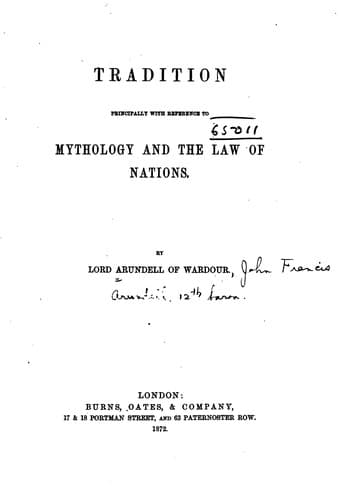
Tradition, Principally with Reference to Mythology and the Law of NationsArundell of Wardour, John Francis Arundell, Baron
Philosophy
Tradition, Principally with Reference to Mythology and the Law of Nations
Arundell of Wardour, John Francis Arundell, Baron
International law; Macdonell, George, 1780-1870; Mythology; Natural law; Tradition (Theology)
[124] I append, however, the following passage from Mr Baring
Gould, as it may be serviceable in tracing tradition, and
to which I may have occasion to recur (p. 161):--"Among the
American Indians an object of worship, and the centre of a
cycle of legend, is Michabo, the great hare or rabbit. From
the remotest wilds of the north-west to the coast of the
Atlantic, from the southern boundaries of Carolina to the
cheerless swamps of Hudson's Bay, the Algonquins are never
tired of gathering round the winter fire, and repeating the
story of Manibozho or Michabo, the Great Hare. With entire
unanimity, their various branches, the Powhatans, &c., ... and
the western tribes, perhaps without exception, spoke of this
'chimerical beast,' as one of the old missionaries called it,
as their common ancestor (Brinton's "Myths of the New World,"
p. 162). Michabo is described as having been four-legged,
monstrous, crouching on the face of the primeval waste of
waters, with all his court, composed of four-footed creatures,
around him. He formed the earth out of a grain of sand taken
from the bottom of the ocean. It is strange that such an
insignificant creature as a hare should have received this
apotheosis, and it has been generally regarded as an instance
of the senseless brute-worship of savages. But its prevalence
leads the mythologist to suspect that some confusion of words
has led to a confusion of ideas, a suspicion which becomes a
certainty when the name is analysed, for it is then found to
be The Great White One, or Great Light, and to be in reality
the sun, a fact of which the modern Indians are utterly
unaware."
If Mr Baring Gould finds that the word Michabo also signifies
"The Great Light," or "The Great White One," it goes far to
identify the worship of the hare with the worship of the
sun, more especially when it is noted (_vide_ Prescott's
"Conquest of Mexico," i. 103) that the hare was one of the
four hieroglyphics of the year among the ancient Mexicans.[A]
Animal worship seems here plainly connected with sun-worship.
But above and beyond it, do we not here also get a glimpse of
more celestial light? "The Great Light" is also "The Great
White One." He is described as "crouching on the face of the
primeval waste of waters." In these phrases we seem almost to
read the text of Gen. i. 3, "And God said, Be light, and light
was made;" ver. 2, "Darkness was on the face of the deep, and
the Spirit of God moved over the waters."
Public-domain text, read in full here on John Shaqi.
Reviews
Reviews
No reviews yet
Be the first to share your thoughts on this work.
Elsewhere in the archive
Join the Discussion
Join the discussion
Sign in to leave a comment or review.
Sign InorCreate an account