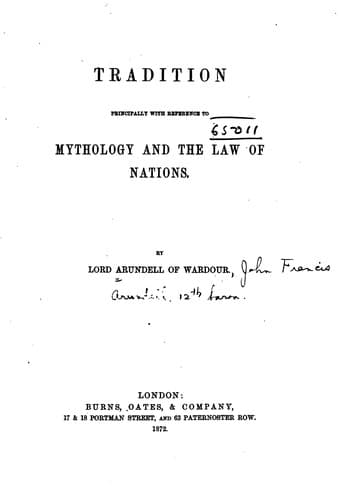
Tradition, Principally with Reference to Mythology and the Law of NationsArundell of Wardour, John Francis Arundell, Baron
Philosophy
Tradition, Principally with Reference to Mythology and the Law of Nations
Arundell of Wardour, John Francis Arundell, Baron
International law; Macdonell, George, 1780-1870; Mythology; Natural law; Tradition (Theology)
which it could be more adequately defined? And when God speaks as "the
God of Abraham, of Isaac, and of Jacob," is it not as if He would
say, I am not only the God who speaks to the individual heart, but
who is _also traditionally_ known to you all collectively through my
manifestations and revelations to your forefathers? Compare Matt. xxii.
32.
_Inter alia_, Mr B. Gould also instances such unmistakable orientalisms
as "'Among the gods there is none like unto Thee, O Lord,' says David,
and he exalts Jehovah above the others as a 'King above all gods.'"
Where, then, may we ask, is the monotheism, "the glory of the Semitic
race," to be found, if not in the time of David?
The proof which follows is more clinching still--
"Jacob seems to have made a sort of bargain with Jehovah that he
would serve Him instead of other gods, on condition that He took
care of him during his exile from home. The _next_ stage in popular
Jewish theology was a denial of the power of the Gentile gods,
and the treatment of them as idols. Tradition and history point
to Abraham as the first on whom the idea of the impotence of the
deities of his father's house first broke. He is said to have
smashed the images in Nahor's oratory, and to have put a hammer
into the hands of one idol which he left standing, as a sign to
Nahor that that one had destroyed all the rest."
Unfortunately for this view--according to the only authentic narrative
we have of the facts, Gen. xii.--Abraham must have preceded Jacob by at
least two generations!
I think that, after this, we may fairly ask Mr Baring Gould, who is
learned in medieval myths, to trace for us more distinctly the notion
of the chronicler who had a theory that Henry II. lived before Henry I.
With this passage I shall conclude this chapter, merely observing, that
if any department of study existed which had for its special object the
investigation of tradition,[124] it is simply impossible that a work
(clever in many respects) such as that of Mr Baring Gould should ever
have been written.
Public-domain text, read in full here on John Shaqi.
Reviews
Reviews
No reviews yet
Be the first to share your thoughts on this work.
Elsewhere in the archive
Join the Discussion
Join the discussion
Sign in to leave a comment or review.
Sign InorCreate an account