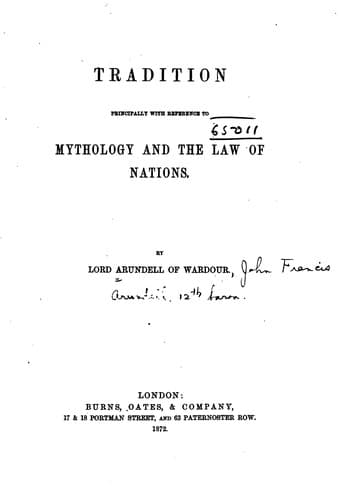
Tradition, Principally with Reference to Mythology and the Law of NationsArundell of Wardour, John Francis Arundell, Baron
Philosophy
Tradition, Principally with Reference to Mythology and the Law of Nations
Arundell of Wardour, John Francis Arundell, Baron
International law; Macdonell, George, 1780-1870; Mythology; Natural law; Tradition (Theology)
F. Schlegel ("Phil. of History," p. 138) says--"The Greeks, who
described India in the time of Alexander the Great, divided the Indian
religious sects into Brachmans and _Samaneans_.... But by the Greek
denomination of _Samaneans_ we must certainly understand the Buddhists,
as among the _rude nations of Central Asia_, as in other countries,
the priests of the religion of Fo bear _at this day_ the name of
_Schamans_." Compare Professor Rawlinson, "Ancient Monarchies," i. 139,
172. (_Vide infra_, p. 163, 164, 205.)
CHAPTER VIII.
_MYTHOLOGY._
Since all antediluvian traditions meet in Noah, and are transmitted
through him, there is an _à priori_ probability that we shall find all
the antediluvian traditions confused in Noah. I shall discuss this
further when I come to regard him under the aspect of Saturn.
As a consequence, we must not expect to find (the process of corruption
having commenced in the race of Ham, almost contemporaneously with
Noah) a pure and unadulterated tradition anywhere; and I allege more
specifically, that whenever we find a tradition of Noah and the Deluge,
we shall find it complicated and confused with previous communications
with the Almighty, and also with traditions of Adam and Paradise.
But inasmuch as the tradition is necessarily through Noah, and in
any case applies to him at one remove, it does not greatly affect
the argument I have in hand. There is a further probability which
confronts us on the outset, that in every tradition, with the lapse
of time, though the events themselves are likely to be substantially
transmitted, they may become transposed in their order of succession.
We shall see this in the case of Noah and his posterity. The principal
cause being, that the immediate founder of the race is, as a rule,
among all the nations of antiquity, deified and placed at the head of
every genealogy and history. "Joves omnes reges vocârunt antiqui."
Thus Belus, whom modern discovery seems certainly to have identified
with Nimrod, in the Chaldean mythology appears as Jupiter, and even
as the creator separating light from darkness (Rawlinson, "Ancient
Monarchies," i. 181; Gainet, "Hist. de l'Anc. et Nouv. Test.," i. 120).
But Nimrod is also mixed up with Jupiter in the god Bel-Merodach. In
more natural connection Nimrod--("who may have been worshipped in
different parts of Chaldea under different titles," Rawlinson, i.
172)--_Nimrod_ appears as the _father_ of _Hurki_ the moon-god, whose
worship he probably introduced; and, what is much more to the point,
he appears as the father of Nin (whom I shall presently identify with
Noah); whilst in one instance, at least, the genealogy is inverted,
and he appears as the _son of Nin_. Thus, too, Hercules and Saturn are
confounded, just as we find Adam and Noah confounded ("many classical
traditions, we must remember, identified Hercules with Saturn," _vide_
Rawlinson, i. 166).
Public-domain text, read in full here on John Shaqi.
Reviews
Reviews
No reviews yet
Be the first to share your thoughts on this work.
Elsewhere in the archive
Join the Discussion
Join the discussion
Sign in to leave a comment or review.
Sign InorCreate an account