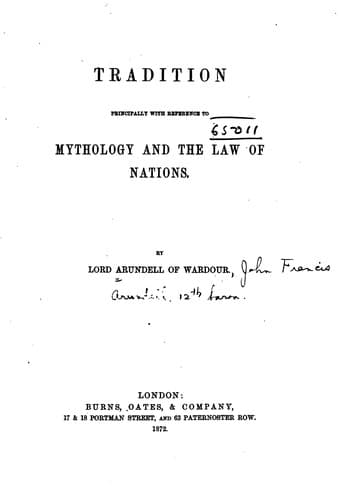
Tradition, Principally with Reference to Mythology and the Law of NationsArundell of Wardour, John Francis Arundell, Baron
Philosophy
Tradition, Principally with Reference to Mythology and the Law of Nations
Arundell of Wardour, John Francis Arundell, Baron
International law; Macdonell, George, 1780-1870; Mythology; Natural law; Tradition (Theology)
Also in Grecian mythology Prometheus (Adam) figures
as the son of Deucalion (Noah), and also of Japetus (Japhet); and so,
too, Adam and Noah, in the Mahabharata, are equally in tradition in the
person of Manou (_vide_ Gainet, i. 199), and in Mexico in the person of
the god Quetzalcoatl (_vide infra_, p. 326).
Before, however, pursuing the special subject of this inquiry further,
it appears to me impossible to avoid an argument on a subject
long debated, temporarily abandoned through the exhaustion of the
combatants, and now again recently brought into prominence through the
writings of Mr Gladstone, Dr Dollinger, Mr Max Müller, and others--the
source and origin of mythology.[126]
[126] This chapter was written before the publication of Mr Cox's
"Mythology of the Aryan Nations." It will be seen, however,
that I indulge the hope that much that is seductive, and much
even that is systematic, in Mr Cox's view, will be found to be
compatible with the line I have indicated.
Now, here, I am quite ready to adopt, in the first place, the opinion
of L'Abbé Gainet, that every exclusive system must come to naught, "que
toutes les tentatives qu'on ai faites pour expliquer le polythéisme par
un système exclusif tombent à faux et n'expliquent rien."
Yet, whilst fully admitting an early and perhaps concurrent admixture
of Sabaism,[127] I consider that the facts and evidence contained in
the pages of Rawlinson will enable us to arrive at the history of
idolatry by a mode much more direct than conjecture. The pages of
Rawlinson prove the identity of Nimrod and Belus, and his worship
in the earliest times. On the other hand, there has been a pretty
constant tradition[128] that Nimrod first raised the standard of
revolt against the Lord; and the erection of the tower of Babel seems
to show a state of things ripe for idolatry. Here recent discovery and
ancient tradition concur in establishing hero-worship as among the
earliest forms of idolatry. But further, the Arab tradition of Nimrod's
apotheosis, analogous to the mysterious and miraculous disappearance
of Enoch (_vide infra_, p. 192), suggests how hero-worship might
become almost identical with the worship of spirits, which L'Abbé
Gainet inclines to think the first and most natural mode. If there was
a tradition among them that one of their ancestors was raised up to
heaven,[129] why may they not have argued, when their minds had become
thoroughly corrupted, that their immediate ancestor, the mighty Nimrod,
had been so raised? and when one ancestor was deified the rest would
have been deified in sequence, or according to their relationship to
him. What, again, more likely than that, when through the corruptions
of mankind the communications of the Most High ceased, they should
turn to those to whom the communications had been made, at first
perhaps innocently in intercession, and, as corruption deepened, in
worship?[130]
Public-domain text, read in full here on John Shaqi.
Reviews
Reviews
No reviews yet
Be the first to share your thoughts on this work.
Elsewhere in the archive
Join the Discussion
Join the discussion
Sign in to leave a comment or review.
Sign InorCreate an account