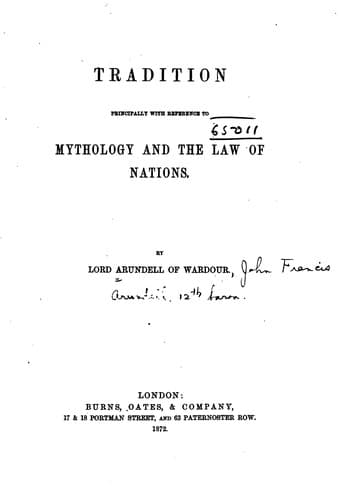
Tradition, Principally with Reference to Mythology and the Law of NationsArundell of Wardour, John Francis Arundell, Baron
Philosophy
Tradition, Principally with Reference to Mythology and the Law of Nations
Arundell of Wardour, John Francis Arundell, Baron
International law; Macdonell, George, 1780-1870; Mythology; Natural law; Tradition (Theology)
[127] Philo. _apud_ Eusebius, who has transmitted the Phoenician
tradition (_vide_ Bunsen's "Egypt," iv. 281), seems to me to
indicate the mode in which it came about in the following
words--"Now Chronos, whose Phoenician epithet was El,
_a ruler of the land_, and subsequently after his death,
_deified_ in the constellation of Kronos (Saturn)," &c. As to
Saturn, _vide_ ch. x.
In the cosmical theory there is analogy as to the process of
deification--"In the Phoenician cosmogonies, the connection
between the highest God and a subordinate male and female
demiurgic principle is of frequent occurrence" (Bunsen, iv.
447). It would seemingly be more in fitness with a cosmical
theory to find direct adoration of the principle, without
evidence of any previous or concurrent process of deification.
Mr W. Palmer ("Egyptian Chronicles," i. 37) says--"But when we
find the rulers of the first two periods in the Chronicle, its
xiii. gods and viii. demigods, answering closely to the two
generations of the antediluvian and post-diluvian patriarchs
in number, and therefore also in the average length of the
reigns and generations; and when we know, besides, as we do,
that the Pantheon of the Egyptians and other nations, which
they said had all borrowed from them, was peopled, in part
at least, _with deified ancestors_--for even the heavenly
luminaries, and the _elements_, and _powers of nature_, and
_notions of the true God still remaining_, or of angels and
demons, so far as they were invested with humanity and sex,
_were identified with human ancestors_; we cannot doubt that
Kronos," &c.
[128] "Venator contra Dominum," St Augustine; "Cité de Dieu," xvi.
ch. iv.; Pastoret, "Hist. de la Legislation."
[129] Gen. v. 24, says only--"And he walked with God, and was
seen no more: because God took him." (_Vide_ also John iii.
13.) There might still have been the belief and tradition
(according to appearances) that he was so raised. (Compare 4
Kings ii. 11, and Ecclesiasticus, xliv. 16.)
[130] I believe, however, that the apostasy in the Hamitic race
generally was much more direct; and I entirely agree with
Bryant that it must have resulted at an early period in a
systematic scheme of mixed solar and ancestral worship.
Therefore, in any Hamitic tradition, we shall not be startled
at finding (even in the commemorative ceremonies of the
Deluge) evidence of solar mythology inextricably blended with
ancestral traditions. We, however, are only concerned with the
ancestral traditions, and in so far as we can discriminate
them, Mr Cox's evidence of solar mythology will form no
barrier to our inquiry.
Public-domain text, read in full here on John Shaqi.
Reviews
Reviews
No reviews yet
Be the first to share your thoughts on this work.
Elsewhere in the archive
Join the Discussion
Join the discussion
Sign in to leave a comment or review.
Sign InorCreate an account