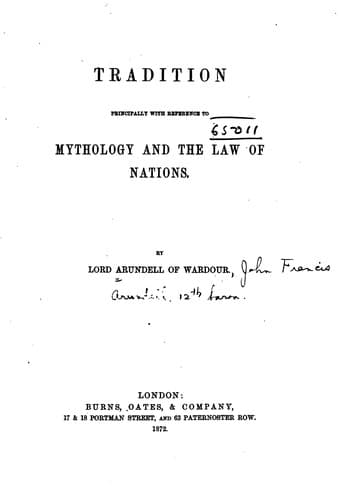
Tradition, Principally with Reference to Mythology and the Law of NationsArundell of Wardour, John Francis Arundell, Baron
Philosophy
Tradition, Principally with Reference to Mythology and the Law of Nations
Arundell of Wardour, John Francis Arundell, Baron
International law; Macdonell, George, 1780-1870; Mythology; Natural law; Tradition (Theology)
This tendency to idolatry through hero-worship seems to me so natural
and direct, that I think, apart from the facts _à priori_, I should
have been led to the conclusion that it was the actual manner in which
it was brought about.[132] It is not denied, on the other hand,
that there always has been a tendency to nature-worship also; and,
indeed, there is probably a stage during which every mythology will
be found to have come under its influence. But the inclination at the
present moment is unmistakably to an exclusive astral or solar system.
The point of interest which excites me to this inquiry is simply to
determine the value of the historical traditions which may lie embedded
in these systems; and I shall be content to find them, whether or not
they form the primary nucleus, or whether only subsequently imported
into, and blended with, solar mythology. It is easy to conceive how a
mythology embodying historical traditions could pass into an astral
system. In this case incongruity would not startle; but it is difficult
to imagine a pure astral system which would not be too harmonious and
symmetrical to admit of the grossness, inconsistency, and incongruity
to which the process of adaptation would inevitably give rise, and to
which hero-worship is inherently prone. As Mr Gladstone says (Homer,
ii. 12):--
"There is much in the theo-mythology of Homer which, if it had
been a system founded on fable, could not have appeared there. It
stands before us like one of our old churches, having different
parts of its fabric in the different styles of architecture, each
of which speaks for itself, and which we know to belong to the
several epochs in the history of the art when their characteristic
combinations were respectively in vogue."
[132] The adverse decision, in the matter of the ceremonies, did
not, I apprehend, touch the question we are now considering,
albeit the ceremonies had reference to deceased ancestors.
This will be apparent, I think, from consideration of the
grounds upon which the question was debated. The Jesuits
relied upon the sense in which the ceremonies were regarded
by the Mandarins and literary men whom they consulted, whilst
their opponents supported their arguments by reference to the
popular notions and the superstitious practices _introduced_
by the Bonzes. (_Vide_ Cretineau Joly's "Hist. de la Com. de
Jesus," vol. v. chap. i.)
Mr Gladstone (_passim_) victoriously combats the theory of
nature-worship as applied to Grecian mythology; but it appears to me
that his argument and mode of reasoning would apply with tenfold effect
to the Chaldean mythology, where there is a likelihood at least that we
shall view idolatry in its early commencements. I consider that this
view is borne out by the following passage from Professor Rawlinson's
"Ancient Monarchies," i. 139:--
Public-domain text, read in full here on John Shaqi.
Reviews
Reviews
No reviews yet
Be the first to share your thoughts on this work.
Elsewhere in the archive
Join the Discussion
Join the discussion
Sign in to leave a comment or review.
Sign InorCreate an account