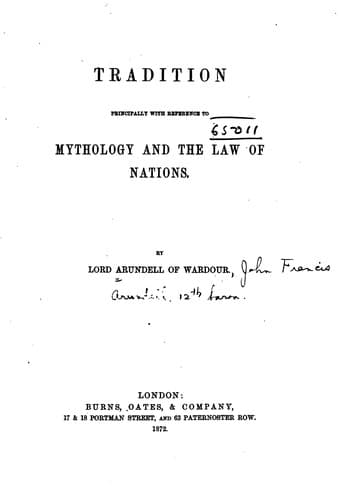
Tradition, Principally with Reference to Mythology and the Law of NationsArundell of Wardour, John Francis Arundell, Baron
Philosophy
Tradition, Principally with Reference to Mythology and the Law of Nations
Arundell of Wardour, John Francis Arundell, Baron
International law; Macdonell, George, 1780-1870; Mythology; Natural law; Tradition (Theology)
"In the first place, it must be noticed that the religion was
to a certain extent _astral_. The heaven itself, the sun, the
moon, and the five planets, have each their representative in
the Chaldean Pantheon among the chief objects of worship. At the
same time it is to be observed, that the astral element is not
universal, but partial; and that even where it has place, it is
but one aspect of the mythology, not by any means its full and
complete exposition. The Chaldean religion even here is far from
being mere Sabeanism--the simple worship of the 'host of heaven.'
The ether, the sun, the moon, and still more the five planetary
gods, are something above and beyond those parts of nature. Like
the classical Apollo and Diana, Mars and Venus, they are real
persons, with a life and a history, a power and an influence, which
no ingenuity can translate into a metaphorical representation
of phenomena attaching to the air and to the heavenly bodies.
It is doubtful, indeed, whether this class of gods are really
of astronomical origin, and not rather primitive deities, whose
characters and attributes were, to a great extent, fixed and
settled before the notion arose of connecting them with certain
parts of nature. Occasionally they seem to represent heroes rather
than celestial bodies; and they have all attributes quite distinct
from their physical and astronomical character.
"Secondly, the striking resemblance of the Chaldean system to that
of the classical mythology, seems worthy of particular attention.
This resemblance is too general and too close in some respects
to allow of the supposition that mere accident has produced the
coincidence."
The evidence in the "Ancient Monarchies" seems to me to decide the
point, not only for perhaps the earliest mythology with which we are
acquainted, but also for the Grecian mythology, which has generally
been the ground of dispute. It is curiously in illustration, however,
of the common origin of mythology, that the mythology of Greece should
be equally well traced to Assyria and Egypt. As evidence of the theory
according to the Assyrian origin, let us turn, for instance, to
Professor Rawlinson's identification of Nergal with Mars. It is true
he appears as the planet Mars under the form of "Nerig," and he also
figures as the storm-ruler; but can anything well be more human than
the rest of his titles?
Public-domain text, read in full here on John Shaqi.
Reviews
Reviews
No reviews yet
Be the first to share your thoughts on this work.
Elsewhere in the archive
Join the Discussion
Join the discussion
Sign in to leave a comment or review.
Sign InorCreate an account