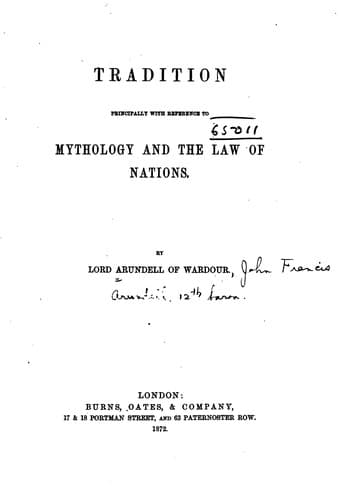
Tradition, Principally with Reference to Mythology and the Law of NationsArundell of Wardour, John Francis Arundell, Baron
Philosophy
Tradition, Principally with Reference to Mythology and the Law of Nations
Arundell of Wardour, John Francis Arundell, Baron
International law; Macdonell, George, 1780-1870; Mythology; Natural law; Tradition (Theology)
The connection of Nimrod with Nergal in the Assyrian mythology, of
Nergal with their planet Nerig, and of the Semitic name of the god
"Aria" with the Greek [Greek: Arês] and the Latin Mars, must, I think,
form a chain of evidence destined to embarass Mr Max Müller and Mr Cox:
for, apart from the numerous points of contact of the Assyrian and
Egyptian with the Greek mythologies, it can hardly be contended that
there was a mythic period for the Aryan which was not common to the
whole human race.
It would be natural to suppose, that a mythology which was generated
in a mythic period--which was the invention of mankind in a peculiar
state of the imagination--would have been developed in its fulness
and completeness, like Minerva starting from the brain of Jupiter,
and would have borne the evidence of its origin in the symmetry of
its form. Mr Max Müller, on the contrary, seems to yield the whole
position, in what, from his point of view, looks like an inadvertent
phrase, that "there were myths before there was a mythology." It is
not that the view is not true, or that it is inconsistent with his
analysis of the myths, but that it is so perfectly consistent with
ours! Incongruity, such as would come from the confusion of separate
myths, would be no difficulty for us; but it is hard to understand how
mere fragmentary legends--sometimes attractive, but more frequently
repulsive and revolting, having no hold on what is nearest the heart of
a people, the traditions of its past--should have been so tenaciously
preserved for so long a time under such different conditions in various
countries.
Solar legends, spun out of confused metaphors, seem an inadequate
explanation, unless we also suppose idolatry of the sun. In that case,
the mythology, in so far as it was solar, would precede the myths; in
other words, the myths would be radiations from a central idea. That
in the day when mankind prevaricated after this fashion, and committed
the act of idolatry in their hearts, everything, from the phenomena
of nature to the remote events of their history, would come under the
influence of a new set of ideas may be easily conceived.
At such a period--and the commencement of these things at least was not
impossible in the days when, in the spirit of mistrust or defiance,
men drew together to build the city and tower in the plain of Sennaar
(Shinar)--much of what Mr Cox supposes to have been the common
parlance of mankind becomes natural, and a mythic period within these
limits conceivable.
But such a theory would not necessarily be exclusive of other forms of
idolatry--as, for instance, the worship of ancestors--whilst it might
clear up obscure points in the evidence which tends to establish the
latter.
The theory, however, must embrace many shades and gradations--from
the Hamitic extreme to the protomyths, which in time obscured the
monotheism of the Aryan of ancient Greece, and of the Peruvian Incas.
(p. 304.)
Public-domain text, read in full here on John Shaqi.
Reviews
Reviews
No reviews yet
Be the first to share your thoughts on this work.
Elsewhere in the archive
Join the Discussion
Join the discussion
Sign in to leave a comment or review.
Sign InorCreate an account