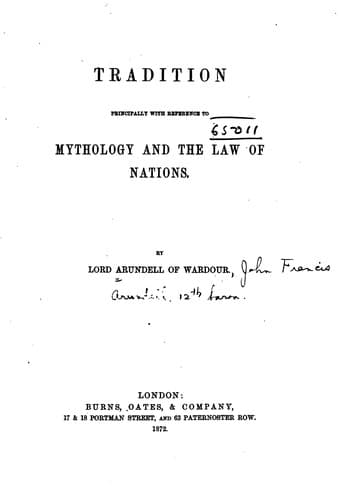
Tradition, Principally with Reference to Mythology and the Law of NationsArundell of Wardour, John Francis Arundell, Baron
Philosophy
Tradition, Principally with Reference to Mythology and the Law of Nations
Arundell of Wardour, John Francis Arundell, Baron
International law; Macdonell, George, 1780-1870; Mythology; Natural law; Tradition (Theology)
"His name is evidently compounded of the two Hamitic roots 'nir' =
a man, and 'gula' = great; so that he is 'the great man' or 'the
great hero.' His titles are 'the king of battle,' 'the champion of
the gods,' 'the strong begetter,' 'the tutelar god of Babylonia,'
and 'the god of the _chase_.'... We have no evidence that Nergal
was worshipped in the primitive times. He is just mentioned by some
of the early Assyrian kings, who regard him as _their ancestor_....
It is conjectured that, like Bil-Nipru, he represents the _deified
hero Nimrod_, who may have been worshipped in different parts of
Chaldea under different titles.... It is probable that Nergal's
symbol was the man-lion. Nir is sometimes used in the inscriptions
in the meaning of lion, and the Semitic name for _the god himself_
is 'aria,' the ordinary term for the king of beasts both in Hebrew
and Syriac. Perhaps we have here the true derivation of the Greek
name for the god of war 'Ares' ([Greek: Arês]), which has _long
puzzled classical scholars_. The lion would symbolise both the
hunting and the fighting propensities of the god, for he not only
engages in combats, but often chases his prey and runs it down like
a hunter. Again, if Nergal is the man-lion, his association in the
buildings with the _man-bull_ would be exactly parallel with the
conjunction which _we so constantly find between him and Nin in the
inscriptions_."[133]--_Rawlinson_, i. 172-174.
[133] "Notwithstanding his stature, beauty, hand, and voice, which
constitute, taken together, a proud appearance, it seems
as if Mars had stood lower in the mind of Homer than any
Olympian deity who takes part in the Trojan war, except Venus
only."--_Gladstone's "Homer,"_ ii. 225.
I must draw attention also to the remarkable absence here of all the
monotheistic epithets we shall find attached to Ana, Enu, and Hoa.[134]
[134] _Vide infra_, next chap. ix.
Let us now turn to the theory which is most in the ascendant, and which
professes to see in the old mythological legends only the thoughts and
metaphors of a mythic period.
This theory, which was Mr Max Müller's in the first instance, being
not only exclusively drawn from the conclusions of philology, but also
exclusive in itself, cannot be anywhere stronger than its weakest point.
If it is shown in the instance of one primary myth, that it was the
embodiment of an historical legend, or theological belief, the whole
ideal structure of a mythic period must collapse; for the rejection of
eclecticism in any form, which would embrace a Biblical or euhemeristic
interpretation of the myths, is at the foundation of Mr Max Müller's
idea, and, indeed, would be incompatible with the theory of a mythic
period such as he conceives it.
Public-domain text, read in full here on John Shaqi.
Reviews
Reviews
No reviews yet
Be the first to share your thoughts on this work.
Elsewhere in the archive
Join the Discussion
Join the discussion
Sign in to leave a comment or review.
Sign InorCreate an account