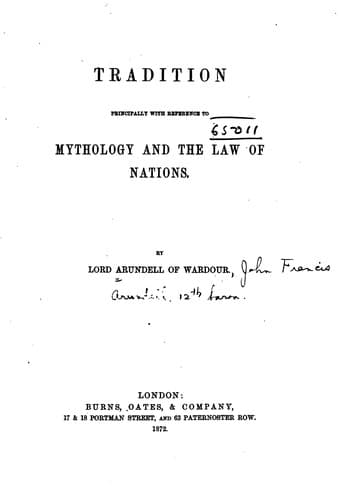
Tradition, Principally with Reference to Mythology and the Law of NationsArundell of Wardour, John Francis Arundell, Baron
Philosophy
Tradition, Principally with Reference to Mythology and the Law of Nations
Arundell of Wardour, John Francis Arundell, Baron
International law; Macdonell, George, 1780-1870; Mythology; Natural law; Tradition (Theology)
[135] Mr Cox ("Mythology," p. xiv.) says--"Mythology, as we call
it now, is simply a collection of the sayings by which men,
once upon a time, described whatever they saw or heard in
the countries where they lived. This key, which has unlocked
almost all the secrets of mythology, was placed in our hands
by Professor Max Müller, who has done more than all other
writers to bring out the exquisite and touching poetry which
underlies those ancient legends. He has shown us that in this,
their first shape, these sayings were all perfectly natural,
and marvellously beautiful and true. We see the lovely
evening twilight die out, &c.... They said that the beautiful
Eurydice," &c. (_vide infra_, p. 173). It would appear,
however, from Mr Cox's more extended work, "The Mythology of
the Aryan Nations," that the sayings of mankind in the mythic
period did not extend to speculations as to their origin and
destiny, or embrace the facts of their history, or the deeds
of their ancestors, but that their whole converse was upon the
sun and moon, and the phenomena of the outward world.
[136] Mr Max Müller makes the distinction between "primitive or
organic legends" (and it is to these I wish to limit the
discussion) "and the second, those which were imported in
later times from one literature to another.... The former
_represents one common ancient stratum of language and
thought_ reaching from India to Europe; the latter consist
of boulders of various strata carried along by natural and
artificial means from one country to another" (ii. 245).
It is clear that Mr Max Müller looks for _harmony_ in his
system--"We naturally look back to the scenes on which the
curtain of the past has fallen, _for we believe that there
ought to be one thought pervading the whole drama of mankind_.
And here history steps in, and gives us the thread which
connects the present with the past" (p. 7). Why it was that
harmony was not attained seems to be disclosed, if we read
the passage in our sense and with a certain transposition of
parts, at p. 3--"There were at Athens then, as there have been
at all times and in all countries, men who had no sense for
the miraculous and supernatural, and who, without having the
moral courage to deny altogether what they could not bring
themselves to believe, endeavoured to find some plausible
explanation _by which the sacred legends_ which _tradition_
had _handed down to them_, and which had been _hallowed_ by
_religious observances_, and sanctioned by the authority of
the law, might be brought _into harmony with_ the dictates of
reason and the _laws_ of _nature_." (Compare with _infra_, p.
351, Maine.)
Public-domain text, read in full here on John Shaqi.
Reviews
Reviews
No reviews yet
Be the first to share your thoughts on this work.
Elsewhere in the archive
Join the Discussion
Join the discussion
Sign in to leave a comment or review.
Sign InorCreate an account