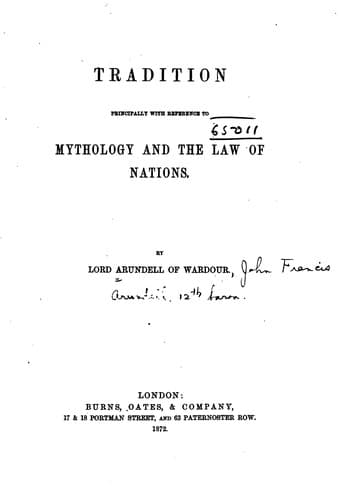
Tradition, Principally with Reference to Mythology and the Law of NationsArundell of Wardour, John Francis Arundell, Baron
Philosophy
Tradition, Principally with Reference to Mythology and the Law of Nations
Arundell of Wardour, John Francis Arundell, Baron
International law; Macdonell, George, 1780-1870; Mythology; Natural law; Tradition (Theology)
I have already hinted that a further consideration appears to me to
incapacitate the theory of nature-worship, in any of its disguises,
from being taken as the exclusive, or even the primitive form of
idolatry, or of perverted tradition; and it is this,--that all the
explanations, even the most ingenious, even those which would be
accounted "primitive and organic," have their counter explanations,
traceable in the corruptions of truth and the perversions of
hero-worship. Take, for instance, the name Zeus, which is in evidence
of the primitive monotheism, and which stood in Greece, as Il or Ra in
Assyria, for the true Lord and God, and which has its equivalents in
Dyaus ("from the Sanscrit word which means 'to shine'"); Dyaus-pater
(Zeus-pater), Jupiter; Tiu (Anglo-Saxon, whence Tuesday); and Zia (High
German)--_vide_ Cox's "Mythology."
What more natural than to associate the Almighty with the heaven
where He dwelt? Mr Max Müller ("Comparative Myth.," "Chips," ii. 72)
says--"Thus [Greek: Zeus], being originally a name of the sky, like
the Sanscrit Dyaus, became gradually a proper name, which betrayed
its appellative meaning only in a few proverbial expressions, such as
[Greek: Zeus hyei], or _sub Jove frigido_." Taking this passage in
connection with what is said (p. 148, of Welcker)--"When we ascend
with him to the most distant heights of Greek history, the idea of God
as the Supreme Being stands before us as a simple fact. Next to the
adoration of one God, the Father of heaven, the Father of men, we find
in Greece a worship of nature." I conclude that Mr Max Müller means,
as Mr Cox means, that the names, Zeus or Dyaus, was applied to the
one true God, whose existence was otherwise and previously known to
them.[137] At starting, therefore, we find that the language borrowed
from nature was only called in to give a colouring and expression to
a previously known and familiar truth; and here, too, we also see the
commencement of incongruity. The simple idea of the heavens might have
been harmoniously extended by the imagination; but, complicated with
the idea of personality, it gave birth to the awkward and incongruous
expression, "[Greek: Zeús huei], or _sub Jove frigido_," a phrase
which never could have been originated by the Grecian mind, unless
the personality of Jove had been the idea most prominently before
the mind. But if the knowledge of the Deity, or even the conception
of the personality of Zeus was operative in the mythic period, it
must have been operative to the extent of embodying what was known or
recollected of his dealings in love and anger with mankind, in the
legends which they wove, and also of blending them with the confusions
which "polyonomy" occasioned. The introduction of this element would
seriously embarass Mr Cox, and would give to Mr Gladstone's explanation
an "_à priori_" probability.
Public-domain text, read in full here on John Shaqi.
Reviews
Reviews
No reviews yet
Be the first to share your thoughts on this work.
Elsewhere in the archive
Join the Discussion
Join the discussion
Sign in to leave a comment or review.
Sign InorCreate an account