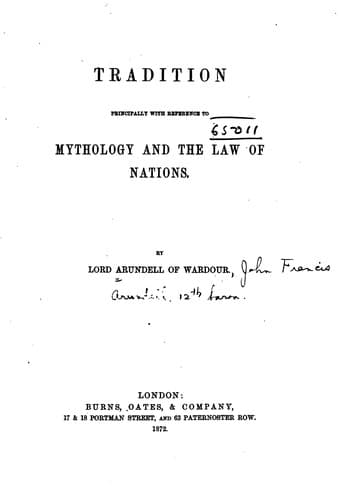
Tradition, Principally with Reference to Mythology and the Law of Nations — John Shaqi
Tradition, Principally with Reference to Mythology and the Law of NationsArundell of Wardour, John Francis Arundell, Baron
Philosophy
Tradition, Principally with Reference to Mythology and the Law of Nations
Arundell of Wardour, John Francis Arundell, Baron
International law; Macdonell, George, 1780-1870; Mythology; Natural law; Tradition (Theology)
"The 'Law of Nations' is an obligation which binds the consciences
of nations to respect the eternal principle of justice in their
relations with each other. 'International law' is the system of
rules, precedents, and maxims accumulated in recognition of the
eternal law. But as men may build a theatre or a gambling-house
upon the foundations constructed for a religious edifice, and
upon a stone consecrated for an altar, so has it been possible
for diplomacy to substitute a system of chicanery for the simple
laws which were intended to facilitate the intercourse of nations,
and with such effect as in a great number of cases to place
international law in contradiction with the law of nations--as,
for instance, when in a certain case the law of nations says that
it is wrong to invade a neighbour's territory, international law
is made to say that it is lawful to invade in such a case, because
such-and-such monarchs in past history have done so.
"Practically the effect of the substitution is, that the sentiment
of justice disappears, that wars which formerly were called unjust,
are now called inevitable, so that good men, disheartened at the
conflicting evidence of precedents, yield their sense of right
and wrong, and defer to the adjudication of diplomatists. This is
particularly satisfactory to the modern spirit which will admit
nothing to be law which is superior to, and distinct from, that
which the human intellect has determined to be law.
"But the sense of right and wrong in good men is that which gives
its whole efficacy to the law of nations. There is nothing else in
the last resort, to restrain the ambition and passion of princes,
but the reprobation of mankind--nothing but the fear of invading
that "moral territory"[9] which even bad men find it necessary
to conquer, '_dans l'ame des peuples ses voisins_.' On the other
hand, the whole mass of precedents to which diplomatists appeal,
which are rarely carefully collated with those which legists have
accumulated and digested, is nothing but a veil which thinly covers
the supremacy of might and the right of force.
"In fact, the conventional deference which is paid to them, is at
best only the hypocritical homage which force is constrained to pay
to justice before it strikes its blow.
Public-domain text, read in full here on John Shaqi.
Reviews
Reviews
No reviews yet
Be the first to share your thoughts on this work.
Join the Discussion
Join the discussion
Sign in to leave a comment or review.
Sign InorCreate an account