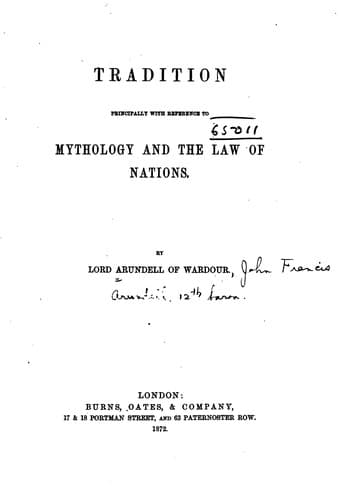
Tradition, Principally with Reference to Mythology and the Law of NationsArundell of Wardour, John Francis Arundell, Baron
Philosophy
Tradition, Principally with Reference to Mythology and the Law of Nations
Arundell of Wardour, John Francis Arundell, Baron
International law; Macdonell, George, 1780-1870; Mythology; Natural law; Tradition (Theology)
[164] Rawlinson says that there is no doubt that Nebo represents
the planet Mercury, and between the attributes of Mercury or
Hermes, the epithets of Nebo, and the traditions concerning
Shem, there is something in common. He is the god of
eloquence and persuasion--the god of alliances and peace.
"He contributed to civilise the manners and cultivate the
minds of the people." "He united them by commerce and good
laws." The Egyptian Mercury or Thaut first invented landmarks.
Finally, "He was consulted by the Titans, his relations, _as
an augur_, which gave occasion to the poets to describe him
as interpreter of the will of the gods."--_L'Abbe de Tressan,
"Mythology."_
The difficulty, however, is in understanding how the worship of Shem
came to Assyria _from_ Babylonia. I can only reconcile it upon a theory
that _all_ idolatry came from Babylonia, _i.e._ from the Hamitic race.
There remains a difficulty which will doubtless occur to every one who
has read the chapter in Rawlinson to which I must acknowledge myself
so much indebted, and it is a difficulty which I ought, perhaps, to
have dealt with before; and that is, that there is in the pages of
Rawlinson (I. vii. 184) the most distinct identification of Noah with
Xisuthrus. Of this there can be no doubt, from his direct connection
with the Deluge, the circumstances of which are perfectly recorded
in the Babylonian tradition.[165] This establishes the fact that the
tradition of Noah and the Deluge was still among them when Berosus
wrote. But if Xisuthrus is Noah, then it may be said Hoa, Oannes, and
Nin cannot be Noah. It is a _non sequitur_, but will still, I fear, be
very influential with many. It is difficult to understand the tendency
to reduplication, and still more difficult to realise how a tradition
so clear and decided could be contemporaneous with other identical
traditions so entangled and confused. I believe this explanation to
be that the account of Xisuthrus was part of the esoteric tradition
to which Rawlinson refers, and which was also the tradition of their
learned men--"Vixere fortes ante Agamemnon";--and we cannot suppose
that Berosus (of whom we should have known nothing if his works had not
been preserved to us at third or fourth hand) was the first chronicler
of his nation.[166]
[165] "Notwithstanding the difficulty of ascending to so distant a
period, there will always be found some traces by which truth
may be discovered.... The historian Josephus relates that the
Chaldæans from the _earliest_ times _carefully preserved_ the
remembrance of past events by public inscriptions on their
monuments. He says they caused these annals to be written by
the wisest men of their nation."--_L'Abbe de Tressan, "Hist.
of Heathen Mythology."_ London, 1806.
Public-domain text, read in full here on John Shaqi.
Reviews
Reviews
No reviews yet
Be the first to share your thoughts on this work.
Elsewhere in the archive
Join the Discussion
Join the discussion
Sign in to leave a comment or review.
Sign InorCreate an account