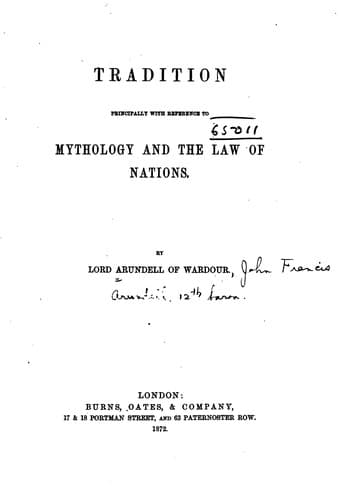
Tradition, Principally with Reference to Mythology and the Law of NationsArundell of Wardour, John Francis Arundell, Baron
Philosophy
Tradition, Principally with Reference to Mythology and the Law of Nations
Arundell of Wardour, John Francis Arundell, Baron
International law; Macdonell, George, 1780-1870; Mythology; Natural law; Tradition (Theology)
I base my conclusion upon the epithets applied to him in common with
Hoa and Nin, and inconsistently applied if, according to the evidence,
p. 177, "mythologically he was a deity of no very great eminence," but
in no way conflicting with the supposition that he represented the
tradition of Noah, the counterpart to the tradition of Hoa and Nin,
among some subordinate nationality, and such appears to be the fact.
"When Nebo first appears in Assyria, it is as a foreign god, whose
worship is brought thither from Babylonia," p. 178.
Of Nebo it is said, "his name is the same or nearly so, both in
Babylonian and Assyrian, and we may perhaps assign it a _Semitic_
derivation, from the root _'nibbah,' to prophesy_. It is his special
function to preside over _knowledge_ and _learning_. He is called 'the
god who possesses intelligence'--'he who hears from afar'--'he who
_teaches_,' or 'he who teaches and instructs.' In this point of view
he of course approximates to Hoa, _whose son_ he is called in some
inscriptions, and to whom he bears a general resemblance. Like Hoa,
he is symbolised by the simple wedge or arrow-head, the primary and
essential element of cuneiform writing, to mark his _joint_ presidency
with that god over writing and literature. At the same time Nebo has,
like so many of the Chaldæan gods, a number of general titles, implying
divine powers, which, if they had belonged to him only, would have
seemed to prove him the supreme deity. He is 'the lord of lords, who
has no equal in power,' _'the supreme chief_,' '_the sustainer_,' 'the
supporter,' the 'ever ready,' 'the guardian over the heavens and the
earth,' 'the lord of the constellations,' 'the holder of the sceptre
of power,' 'he who grants to kings the sceptre of royalty for the
_governance_ of their people'" (Rawlinson, i. 177).
There is just a possibility, however, that Nebo may be Sem or Shem. He
would be the son of Hoa as Nebo was stated to be.
I think, moreover, a striking resemblance will be seen between the
above epithets and the traditions concerning _Shem_, collected by
Calmet (Dict. "Sem.")
"The Jews attribute to Sem the theological _tradition_ of the
_things which Noah taught to the first men_.... They say that he is
the same as Melchisedek.... In fine, the Hebrews believe that he
taught _men the law of justice_, the manner of counting the months
and years, and the intercalations of the months. They pretend that
_God gave him the spirit of prophecy_ one hundred years after the
Deluge, and that he continued _to prophesy_ during four hundred
years, with little fruit among mankind, who had become very
corrupt. Methodius says that he remained in the isle of the sun,
that he invented astronomy, and that he was _the first king who
ruled over the earth_."[164]
Public-domain text, read in full here on John Shaqi.
Reviews
Reviews
No reviews yet
Be the first to share your thoughts on this work.
Elsewhere in the archive
Join the Discussion
Join the discussion
Sign in to leave a comment or review.
Sign InorCreate an account