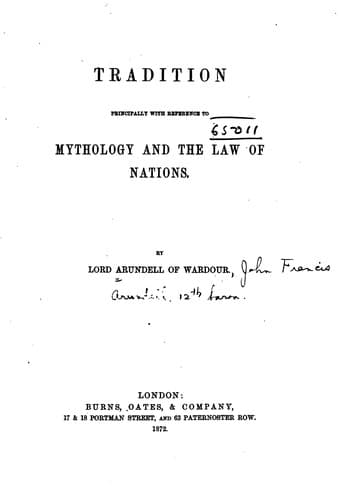
Tradition, Principally with Reference to Mythology and the Law of NationsArundell of Wardour, John Francis Arundell, Baron
Philosophy
Tradition, Principally with Reference to Mythology and the Law of Nations
Arundell of Wardour, John Francis Arundell, Baron
International law; Macdonell, George, 1780-1870; Mythology; Natural law; Tradition (Theology)
I. And in the first place, "Him of mazy counsel, Saturn," the
expression of Hesiod ([Greek: t' Iapeton te ide Kronon agkylomêtên]),
Hesiod. Theog. v. 19, which so well befits the intermediary between God
and the survivors of the Deluge. "Under Saturn," as Plutarch tells us,
"was the golden age." Calmet says (Dict. "Saturne"), "Quant aux traits
de ressemblance qui se trouvent entre Noë et Saturne, ils ne peuvent
être plus sensibles.[167] Il (Saturne) est représenté avec une faulx
comme inventeur de l'agriculture[168]: Noë est nommé 'vir agricola'
(Gen. ix. 20) et il est dit qu'il commença à cultiver la terre. Les
_Saturnales_, qu'on célébrait dans le vin et dans la licence et _où
les serviteurs s'égaloient à leurs maitres_--marquent l'ivresse de
Noë et sa malédiction qui assujettit Chanaan à ses frères tout égal
qu'il leur étoit par sa naissance." [I have _little doubt that this
Bacchanalian recollection originated the tradition of the equality of
conditions_ in the _golden_ age, contrary to the facts of Scripture and
history.] "On disoit que Noë avait dévoré tous ses enfans à l'exception
de Jupiter, de Neptune, et de Pluton. Noë vit périr dans les eaux du
déluge tous les hommes de son temps dont plusieurs étoient ses parents
et plus jeunes que lui. Dans la stile de l'écriture on dit souvent que
l'on fait ce qu'on n'empêche pas, ou même ce que l'on prédit." Further
resemblances are traced in Calmet.
[167] Bochart also says (Geog. Sacra, lib. i.) "Noam esse Saturnum
tam multa docent, ut vix sit dubitandi locus."
[168] "Cum falce, messis insigne."--_Macrobius, "Saturn."_
Now, I find in Sanchoniathon,[169] _i.e._ in the most ancient
Phoenician historian, a tradition running exactly parallel with this
Greek tradition as interpreted by Calmet:--"Ces genies, ces sages, ces
dieux, nous expliquent les autres dieux qui, d'après Berose, forment
l'homme du sang de Bélus, et tous les dieux que Sanchoniaton nous
représente saisis d'épouvante _à la vue de Saturne, faisant périr par
le déluge son fils Sadid_."--(Le Peuple Primitif; Rougemont, i. 303,
quoted by Gainet, iii. 561, with reference to the worship of spirits.)
I adduce it in evidence of the connection in tradition between Saturn
and the Deluge, and in corroboration of Calmet's interpretation, which
clears the Greek myth of what is grotesque and repulsive in it.
[169] Sanchoniathon, _vide supra_ M'Lennan (ch. vii.)
If I have sufficiently identified Saturn with Noah and the period of
the Deluge, the lines of Virgil (Æneid, 8th Book, 315), besides bearing
testimony in the same direction, appear to me to acquire a new meaning
and significance:--
"Primus ab ætherio venit _Saturnus_ Olympo,
Arma Jovis fugiens, _et regnis exul ademptis_,
Is genus indocile, ac dispersum montibus altis
Composuit; _legesque dedit_; Latiumque vocari
Maluit."...
Public-domain text, read in full here on John Shaqi.
Reviews
Reviews
No reviews yet
Be the first to share your thoughts on this work.
Elsewhere in the archive
Join the Discussion
Join the discussion
Sign in to leave a comment or review.
Sign InorCreate an account