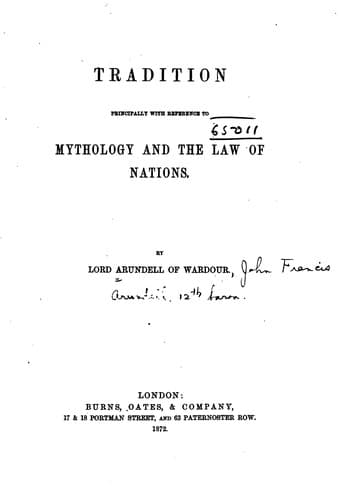
Tradition, Principally with Reference to Mythology and the Law of NationsArundell of Wardour, John Francis Arundell, Baron
Philosophy
Tradition, Principally with Reference to Mythology and the Law of Nations
Arundell of Wardour, John Francis Arundell, Baron
International law; Macdonell, George, 1780-1870; Mythology; Natural law; Tradition (Theology)
"_Aurea_, quæ perhibent, _illo sub rege_ fuerunt
_Sæcula_; sed placidâ populos in pace regebat,
Deterior donec paulatim ac discolor ætas
Et belli rabies et amor successit habendi."[170]
[170] Bryant (Mythology, ii. 261) says:--"He is by Lucian made to
say of himself [Greek: oudeis hyp' emou doulos ên]. The Latins
in great measure confine his history to their own country,
where, like Janus, he is represented as refining and modelling
mankind, and giving them laws. At other times he is introduced
as prior to law; which are seeming contrarieties very easy to
be reconciled." There were traditions also of Saturn in Crete
and Sparta.--_Bryant_, iii. 414.
Allowing for the confusion incidental to the deification of Noah in the
person of Saturn, which necessitates his descent from heaven, the rest
of the verses seem merely to describe what is recorded in tradition,
if not implied in the scriptural narrative, that Noah, a voyager and
exile, his possessions having been lost in the Flood, flying the
wrath--not indeed as directed against himself, but the consequences of
the wrath of the Almighty[171]--persuaded the survivors of the Flood
to abandon the mountains, to which they clung in fear of a second
Deluge, and brought them into the plains, incited and encouraged by his
example,--he who, if he be the same (_vide supra_, 208, 209) with
Nin and Nebo, we have seen called "the sustainer," "the supporter,"
"he who strengthens the hearts of his followers," who taught them the
cultivation of the soil, and of whom it is now said more distinctly
than we have seen it heretofore stated, _legesque dedit_.[172]
[171] _Vide supra_, p. 211.
[172] An indirect argument in proof of the identity of Saturn
and Noah might be adduced if I had space to incorporate
Boulanger's evidence of the ceremonies among the ancients'
commemoration of the Deluge, ("Vestiges d'usages
hydrophoriques dans plusieurs fêtes anciennes et modernes").
This being assumed, is it not of some significance that when
the Roman pontiffs proceeded to the banks of the Tiber to
perform their annual (commemorative) ceremonial, that they
should make their expiatory sacrifices to Saturn? The points
that Bryant takes (ii. 262) are very striking:--"He was looked
upon as the _author_ of time, 'Ipse qui _auctor_ temporum'
(Macrob. i. 214). [His medals had on the reverse the figure
of _a ship_.] They represented him as of an uncommon age,
with hair white as snow; they had a notion that he _would
return to second childhood_. 'Ipsius autem canities primosis
nivibus candicabat; _licet etiam ille puer posse fieri
crederetur_.'--Martianus Capella. Martial's address to him,
though short, has in it something remarkable, for he speaks of
him as a native _of the former world_--
Public-domain text, read in full here on John Shaqi.
Reviews
Reviews
No reviews yet
Be the first to share your thoughts on this work.
Elsewhere in the archive
Join the Discussion
Join the discussion
Sign in to leave a comment or review.
Sign InorCreate an account