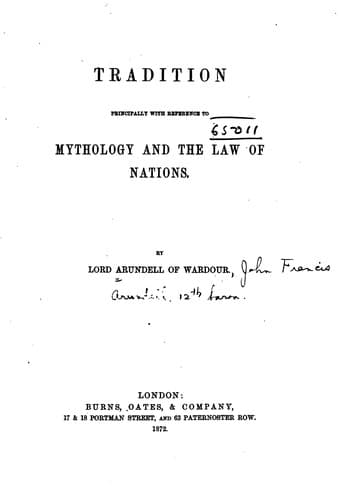
Tradition, Principally with Reference to Mythology and the Law of NationsArundell of Wardour, John Francis Arundell, Baron
Philosophy
Tradition, Principally with Reference to Mythology and the Law of Nations
Arundell of Wardour, John Francis Arundell, Baron
International law; Macdonell, George, 1780-1870; Mythology; Natural law; Tradition (Theology)
But as the legends of Saturn are not all derived from Noah, so neither
do all the traditions concerning Bacchus appertain to Saturn. I shall
simply separate and note such as appear to me to be in common, _e.g._
"that Bacchus found out the making of wine, the art of planting trees,
and many things else commodious for mankind." ["And Noah, a husbandman,
began to till the ground, and planted a vineyard, and drinking the
wine was made drunk," Gen. ix. 20.][175] It is said there were several
Bacchuses. This may be only a reduplication, such as we have seen in
the case of Oannes, Nin, and Nebo, or as in the multiplications of
Jupiter. "Joves omnes reges vocarunt antiqui."[176]
[175] "The Scriptures tell us that Noah cultivated the vine; and
all profane historians agree in placing Bacchus in the first
ages of the world" (in proof of early cultivation of the
vine).--Goguet, "Origin of Laws," i. 116. Compare _supra_,
p. 213, "Saturnus _Sator_." Bryant says, "The history of
Dionusus is closely connected with that of Bacchus, though
they are two distinct persons." He supposes Dionusus to be
Noah, and Bacchus Ham. But he may very well have embodied the
traditions of both. Pausanius (lib. iii. 272) says Dionusus
was exposed _in an ark_ and wonderfully _preserved_. He
was also said to have been twice born, and to have had two
fathers and two mothers, in allusion to the two periods of his
existence separated by the Deluge.
Dionusus (Orphic Hymn, 44, 1) is addressed as [Greek: elthe,
makar Dionyse, pyrispore tauroumetôpe].
[176] The phrase "Father Bacchus," current among the ancients
(_vide_ Hor. Odes. i. xviii.) has always struck me as
singular. It is perfectly congruous with the tradition of
Noah; but who will tell us its appropriate solar or astral
application?
On this subject Montfauçon says (i. 155)[177] apropos of a point to
which I shall again refer, viz. that Bacchus was _Tauri_cornis.
"Diodorus Siculus says that the horns are only ascribed to the
second Bacchus, the son of Jupiter and Proserpine; but these
distinctions of various Bacchus were minded only in the more
ancient times, hardly known in their worship.... This will also
hold good of most of the other gods who were multiplied in the same
manner."
Public-domain text, read in full here on John Shaqi.
Reviews
Reviews
No reviews yet
Be the first to share your thoughts on this work.
Elsewhere in the archive
Join the Discussion
Join the discussion
Sign in to leave a comment or review.
Sign InorCreate an account