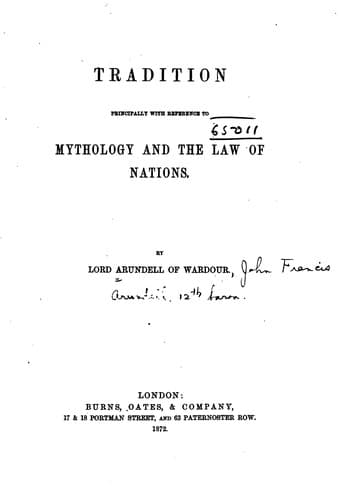
Tradition, Principally with Reference to Mythology and the Law of NationsArundell of Wardour, John Francis Arundell, Baron
Philosophy
Tradition, Principally with Reference to Mythology and the Law of Nations
Arundell of Wardour, John Francis Arundell, Baron
International law; Macdonell, George, 1780-1870; Mythology; Natural law; Tradition (Theology)
[177] Montfauçon, from whom I have quoted, was simply an
antiquarian--a very erudite and laborious antiquarian, but one
whose sole concern was to discriminate facts without reference
to their bearings, and who would have had, I have little
doubt, a supreme contempt for the speculations in which I have
indulged. He says in his preface--"I have a due regard for
those great men who have excelled in this sort of learning,
but must own at the same time I have no taste for it.... _It
signifies very little to us to know_ whether they who tell us
Vulcan was the same with Tubalcain, or they who say he was the
same with Moses, make the best guess in the matter." Though
the general opinion may not incline any more now than then
to the biblical interpretation, yet I think a great change
has taken place in public opinion as to the importance of the
inquiry.
Triptolemus was also said to have been "the inventor of
the plough and of agriculture, and of civilisation, which
is the result of it," and to have instituted the Elusinian
mysteries. Like Bacchus he is also said to have "ridden all
over the earth, making men acquainted with the blessings of
agriculture."--_Smith. Myth. Dict.; vide_ also _infra_, p.
224: "Deucalion."
Vicomte d'Anselme (Gainet, i. 224), asks with reference to his Greek
name of Dionysius, "Pourquoi les Grecs donnaient-ils le nom de Dionysos
ou de divin Noush (dios nous ou Noë) à l'inventeur du vin?"--_Vide
supra_, ch. ix.; vide also Gainet, i. 225.
Bacchus is by some called "_Tauri_cornis" (compare _supra_, p. 203,
Nin) "or Bucornis, and moreover he is frequently so represented,"
(_i.e._ not only with the horn in hand, a "_bull's_ horn," as he is
sometimes, which might be a drinking horn or cornucopia, in its way
emblematical of the vir agricola"), "but also with horns on the head.
Horace calls him "Bicorniger," Orpheus, [Greek: Boukerôs]; Nicander,
[Greek: Taurokerôs]."--_Montfauçon_, i. 147, 155; comp. p. 204, note to
"Nin."
One Bacchus, Cicero tells us, "was King of Asia and author of the
_Laws_ called Subazian."--_Montfauçon_, i. 144. It is, moreover, said
that Bacchus travelled through all nations as far as India,[178] doing
good in all places, and teaching many things profitable to the life of
man. His conquests are said to have been easy and without bloodshed.
But it is also noted that amidst his benevolence to mankind, he was
relentless in punishing all want of respect for his divinity, and
indeed the _conduct_ and punishment of Chanaan may be said to be
narrated in the history of Pentheus.--_Vide_ _Montf._ i. 161.[179]
Public-domain text, read in full here on John Shaqi.
Reviews
Reviews
No reviews yet
Be the first to share your thoughts on this work.
Elsewhere in the archive
Join the Discussion
Join the discussion
Sign in to leave a comment or review.
Sign InorCreate an account