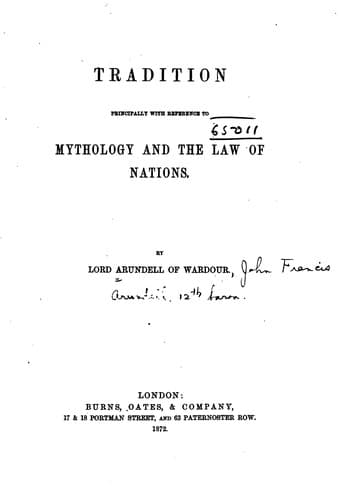
Tradition, Principally with Reference to Mythology and the Law of NationsArundell of Wardour, John Francis Arundell, Baron
Philosophy
Tradition, Principally with Reference to Mythology and the Law of Nations
Arundell of Wardour, John Francis Arundell, Baron
International law; Macdonell, George, 1780-1870; Mythology; Natural law; Tradition (Theology)
[183] "Megasthenes stated that the first king (of India) was
Dionysus. He found a rude population in a savage state,
clothed in skins, unacquainted with agriculture, and without
fixed habitations. The length of his reign is not given. The
introduction of civilization and agriculture is a natural
allusion to the immigration of the Aryans into a country
inhabited by Turanian races.... Fifteen generations after
Dionysus, Hercules reigned.... Now all this is obviously pure
Indian tradition. Dionysus is the elder Manu, the divine
primeval man, son of the Sun (Vivasvat). He holds the same
position in the primeval history of India as does Jima or
Gemshid, another name of the primeval man in the Iranian
world.... The first era, then, is represented by Megasthenes
as having fourteen generations of human kings, with a god as
the founder and a god as the destroyer of the dynasty, in
all fifteen or sixteen generations."--_Bunsen's Egypt_, iii.
528. Compare those fifteen generations with Palmer. Compare
the confusion of Dionysus and Hercules with Deucalion and
Prometheus, &c., p. 232. Pelasgus among the Arcadians passed
for the first man and the first legislator (Boulanger, i.
133). Of Cadmus, too, it is said--"Greece is indebted to him
for alphabetical writing, the art of _cultivating the vine_,
and the forging and working of _metals_."--_Goguet_, ii. 41.
[184] _Vide supra_, Oannes, ch. ix.; _vide_ Smith, "Myth. Dict."
To return to Janus. Before concluding I must note that Janus is called
Eanus by Cicero, which may perhaps have analogy with "Hea and Hoa" (ch.
ix.), and with Eannes and "Oannes," although Cicero derives it from
"eundo."
Janus was also called "consivius a conserendo," because he presided
over generation, a title singularly appropriate to Noah as the second
founder of the race, and through whom the injunction was given
"to increase and multiply."[185] He is moreover called "Quirinus
or Martialis," "because he presided over war," which is precisely
the aspect under which it is the original and main purpose of this
dissertation to consider Noah; and here I think I am entitled to urge,
that if I have succeeded on other grounds in showing that Nin, Hoa,
Janus, &c., represented Noah, then that these epithets, "Quirinus,"
"Martialis," "King of Battle," &c., can only be applied to him whose
conquests were bloodless in the sense of controlling and regulating
war.[186] In connection with this title of "Martialis," as applied to
Janus--and, by the by, all the traditions concerning him are altogether
peaceful and bloodless--it will be remembered that his temple was open
in war and shut in peace, and closed for the third and last time at the
moment of the birth of our Lord.
Public-domain text, read in full here on John Shaqi.
Reviews
Reviews
No reviews yet
Be the first to share your thoughts on this work.
Elsewhere in the archive
Join the Discussion
Join the discussion
Sign in to leave a comment or review.
Sign InorCreate an account