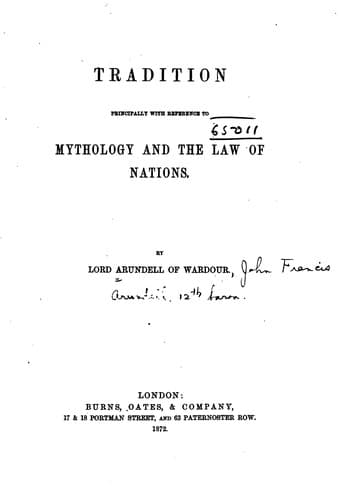
Tradition, Principally with Reference to Mythology and the Law of NationsArundell of Wardour, John Francis Arundell, Baron
Philosophy
Tradition, Principally with Reference to Mythology and the Law of Nations
Arundell of Wardour, John Francis Arundell, Baron
International law; Macdonell, George, 1780-1870; Mythology; Natural law; Tradition (Theology)
[182] Bryant ("Mythology," ii. 254) says, "Many persons of great
learning have not scrupled to determine that Noah and Janus
were the same. By Plutarch he is called [Greek: Iannos], and
represented as an ancient prince who reigned in the infancy of
the world.... He was represented with two faces, with which he
looked both forwards and backwards; and from hence he had the
name of Janus Bifrons. One of these faces was that of an aged
man; but in the other was often to be seen the countenance
of a young and beautiful personage. About him ... many
emblems.... There was particularly a _staff in one hand_, with
which he pointed to a rock, from whence issued a profusion of
water. In the other hand he held a key.... He had generally
near him _some resemblance of a ship_.... Plutarch does not
accede to the common notion" (that it was the ship that
brought Saturn to Italy), "but still _makes it a question why_
the coins of this personage bore on one side the resemblance
of Janus Bifrons, and on the other the representation of
either the hind part or the fore part _of a ship_.... He
is said to have first composed a chaplet, and to him they
attributed the _invention of a ship_. Upon the Sicilian coins
(at the temple) of Eryx _his_ figure often occurs with a
twofold countenance, and on the reverse _is a dove_ encircled
with a crown, which seems _to be of olive_. He is represented
as a _just man_ and _a prophet_ (comp. pp. 207-208), and had
the remarkable characteristics of being in a manner the author
of time and the god of the year."
But not only were Saturn, Janus, and Bacchus represented as "bifrons,"
but so also was Cecrops. Cecrops will present a difficulty the more
in the way of any solar theory; but Cecrops,[183] like all founders
or supposed founders of states, has something in common with Noah.
Like Saturn and Janus in Italy, Cecrops was said to have brought the
population of Attica into cities, to have given them laws, taught
them the worship of the idols, _planted the olive_, and finally, was
represented as half man, half serpent.[184]
Public-domain text, read in full here on John Shaqi.
Reviews
Reviews
No reviews yet
Be the first to share your thoughts on this work.
Elsewhere in the archive
Join the Discussion
Join the discussion
Sign in to leave a comment or review.
Sign InorCreate an account