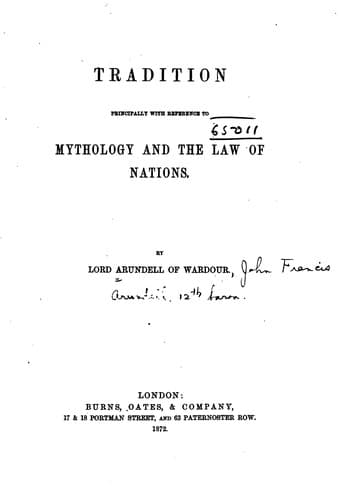
Tradition, Principally with Reference to Mythology and the Law of NationsArundell of Wardour, John Francis Arundell, Baron
Philosophy
Tradition, Principally with Reference to Mythology and the Law of Nations
Arundell of Wardour, John Francis Arundell, Baron
International law; Macdonell, George, 1780-1870; Mythology; Natural law; Tradition (Theology)
"These words ('the earth was without form and void, and darkness
was upon the face of the deep; but the Spirit of God moved upon
the face of the waters,' Gen. x.), which announce the presage of a
new morn of Creation, not only represent a darker and wilder state
of the globe, but very clearly show the element of water to be
still in predominant force. Even the division of the elements, of
the waters above the firmament, and of the waters below it, on the
second day of creation, the permanent limitation of the sea for the
formation and visible appearance of the dry land, necessarily imply
a mighty revolution in the earth, and afford additional proof that
the Mosaic history speaks not only of one but of many catastrophes
of nature, _a circumstance that has not been near enough attended
to in the geological interpretation and illustration of the
Bible_."--_Schlegel_, p. 82.
[196] Kenrick (p. 37) says:--"The fact of traces of the action of
water at a higher level in ancient times on these shores
is unquestionable; under the name of _raised beaches_
such phenomena are familiar to geologists on many coasts;
but that the tradition (in Samothrace) was produced by
_speculation_ on its _cause_, not by an obscure recollection
of its _occurrence_, is also clear; for it has been shown by
physical proofs that a discharge of the waters of the Euxine
(Black Sea) would not cause such a deluge as _the tradition
supposed_" (Cuvier, Disc. sur les Revolutions du Globe, ed.
1826).
If these speculations were made at the commencement of
Grecian history, and the speculations had reference to
evidence of diluvian disruption along the highway by which
they passed into Greece, should we not expect that theories
of the violent rather than the gentler and gradual action of
water would dominate in their geological tradition? Colonel
George Greenwood, in "Rain and Rivers," p. 2, says on the
contrary--("with reference to the theory that valleys are
formed by 'rain and rivers'")--"There is, perhaps, no creed
of man which, like this, can be traced up to the most remote
antiquity, and traced down from the most remote antiquity to
the present day. Lyell has himself quoted Pythagoras for it,
through the medium of Ovid:--
'Eluvie mons est deductus in æquor
Quodquo fuit campus _vallem decursus aquarum_
Fecit.'
Public-domain text, read in full here on John Shaqi.
Reviews
Reviews
No reviews yet
Be the first to share your thoughts on this work.
Elsewhere in the archive
Join the Discussion
Join the discussion
Sign in to leave a comment or review.
Sign InorCreate an account