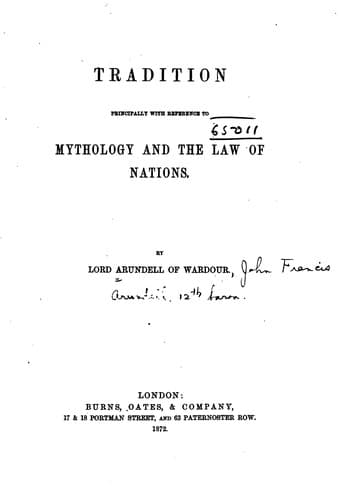
Tradition, Principally with Reference to Mythology and the Law of NationsArundell of Wardour, John Francis Arundell, Baron
Philosophy
Tradition, Principally with Reference to Mythology and the Law of Nations
Arundell of Wardour, John Francis Arundell, Baron
International law; Macdonell, George, 1780-1870; Mythology; Natural law; Tradition (Theology)
But Pythagoras only enunciates the doctrine of Eastern
antiquity; that is, of the Egyptians, the Chaldæans, and
the Hindoos. But since Pythagoras introduced this doctrine
in the West, if it has ever slumbered, it has perpetually
_re_-originated. Lyell shows that among the Greeks it was
taught by Aristotle; among the Romans by Strabo; among the
Saracens by Avicenna; in Italy by Moro, Geneselli, and
Targioni; and in England by Ray, Hutton, and Playfair."--_Rain
and Rivers_, by Col. George Greenwood. Longmans, 1866. 2d edit.
The point that is material to this discussion is to decide whether or
not those disruptions in Thrace are historical and subsequent to the
Deluge. Now, here Mr Kenrick's main theory, that "speculation is the
source of tradition," comes in with fatal effect to dispose of the
arguments I am combating, and yet in no way at this point militates
against the view I am urging, that these supposed inundations were
localisations of the tradition of the general Deluge which the Pelasgi
brought with them from Asia.
Mr Kenrick says (p. 36):--
"It was a [Greek: logos], a popular legend, among the Greeks,
that Thessaly had once been a lake, and that Neptune had opened a
passage for the waters through the vale of Tempe (Herod. 7, 129).
The occupation of the banks of the rivers of this district by the
Pelasgi tribes, which must have been _subsequent_ to the opening
of the gorge, is the _earliest_ fact in Greek history, and the
'logos' itself no doubt originated in a very simple speculation.
The sight of a narrow gorge, the sole outlet of the waters of a
whole district, naturally suggests the idea of its having once been
closed, and, as the necessary consequence, the inundation of the
whole region which it now serves to drain."
Now, if this reasoning is just, it seems to establish two things pretty
conclusively: First, That the current legend among the Greeks was _not_
the tradition of a local deluge; but, if not a reminiscence, was at any
rate the observation of the evidences of a deluge previous to their
arrival. Moreover, the deluge of their tradition exceeding the actual
facts is in evidence of their recollection of an event adequate to such
effects. Second, That the tradition, if it arose out of a speculation,
must have arisen out of a speculation made in the earliest commencement
of Greek history.
It is difficult to reconcile the latter conclusion with Mr Kenrick's
view that the tradition was imported from Asia in the fifth century
B.C.
It is impossible to reconcile the former with the acceptation of a
local and historical inundation in the time of the Ogyges and Deucalion
of popular history.
Public-domain text, read in full here on John Shaqi.
Reviews
Reviews
No reviews yet
Be the first to share your thoughts on this work.
Elsewhere in the archive
Join the Discussion
Join the discussion
Sign in to leave a comment or review.
Sign InorCreate an account