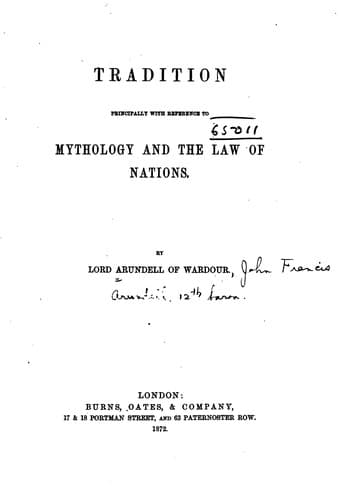
Tradition, Principally with Reference to Mythology and the Law of NationsArundell of Wardour, John Francis Arundell, Baron
Philosophy
Tradition, Principally with Reference to Mythology and the Law of Nations
Arundell of Wardour, John Francis Arundell, Baron
International law; Macdonell, George, 1780-1870; Mythology; Natural law; Tradition (Theology)
_Phoroneus_, "an ancient poet quoted by Clemens Alex. (i. 380)
calls him the first of mortals, [Greek: phyroneus patêr thnêtôn
anthrôpôn]." The first deluge took place under Phoroneus: "He
was also the first who _built_ an altar. He first collected men
together and formed them into petty communities."--Pausanias, lib.
2, 145. He first gave laws and distributed justice.--Syncellus,
67, 125. They ascribed to him the distribution of mankind, "idem
nationes distribuit" (Hyginus' Fab. 143), "which is a circumstance
very remarkable."
_Poseidon's_ epithets connected with the ark are very striking
(Bryant, ii. 269, _Deucalion, vide ante_, p. 232); but he is also
said (Apollon. Rhod. lib. 3, v. 1085) to have been "the first man
through whom religious rites were renewed, cities built, and civil
polity established in the world."
_Cecrops_ (_vide ante_, p. 220), the identical terms are used.
_Myrmidon_, "a person of great justice." "He is said to have
collected people together, humanised mankind, enacted laws, and
first established civil polity."--Scholia in Pindar, Ode 3, v. 21.
_Cadmus, vide ante_, p. 221.
_Pelasgus_ also is described as equally a benefactor to mankind,
and instructed them in many arts.--Pausanias, 8, 599. He is said to
have built the first temple to the deity "ædem Jovi Olympis primum
fecit Pelasgus."--Hyginus' Fab. 225, 346. Bryant says, "I have
taken notice that as Noah was said to have been [Greek: hanthrôpos
gês]," a man of the earth--this characteristic is observable in
every history of the primitive persons; and they are represented
as '[Greek: nomioi],' '[Greek: agrioi]', and '[Greek: gêgeneis].'
Pelasgus accordingly had this title (Æschy. "Supplicants," v. 250),
and it is particularly mentioned of him that he _was the first_
husbandman. Pelasgus first found out all that is necessary for the
cultivation of the ground."--Schol. in Eurip. "Orestes," v. 930.
_Osiris._--The account of Osiris in Diodorus Siculus is exactly
similar. He travels into all countries like Bacchus. He builds
cities; and although represented as at the head of an army, is
described with the muses and sciences in his retinue. In every
region he instructed the people in planting, sowing, and other
useful acts.--Tibullus, i. E. 8, v. 29. He particularly introduced
the vine, and when that was not adapted to the soil, the use of
ferment and wine of barley. He first built temples, and was a
lawgiver and king (Diod. Sic.).--Bryant, ii. 60.
_Chin-nong_ (_vide_ also Bunsen, _supra_, p. 63) "was a
husbandman, and taught the Chinese agriculture, &c., discovered the
virtues of many plants. He was represented with the _head of an
ox_, and sometimes only with two horns."--Comp. Bryant, iii. 584.
_Manco Capac._--Peru, _vide infra_, ch. xiii.; very curious.
Public-domain text, read in full here on John Shaqi.
Reviews
Reviews
No reviews yet
Be the first to share your thoughts on this work.
Elsewhere in the archive
Join the Discussion
Join the discussion
Sign in to leave a comment or review.
Sign InorCreate an account