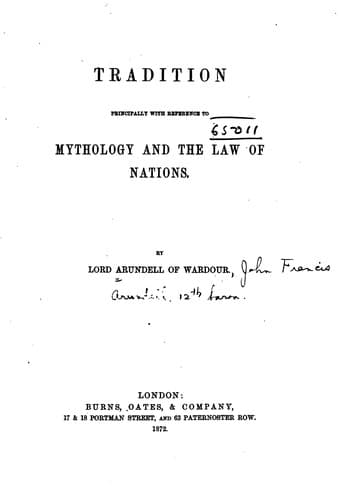
Tradition, Principally with Reference to Mythology and the Law of NationsArundell of Wardour, John Francis Arundell, Baron
Philosophy
Tradition, Principally with Reference to Mythology and the Law of Nations
Arundell of Wardour, John Francis Arundell, Baron
International law; Macdonell, George, 1780-1870; Mythology; Natural law; Tradition (Theology)
[200] Layard ("Nineveh and Babylon," p. 343) says, "We can scarcely
hesitate to identify this mythic form (at Kosyundik) with the
Oannes or sacred man-fish, who, according to the traditions
preserved by Berosus, issued from the _Erethræan_ sea,
instructed the _Chaldæans_ in all wisdom, in the sciences
and the fine arts, and was _afterwards_ worshipped as a
god in the temples of Babylonia.... Five such monsters
rose from the Persian Gulf at fabulous intervals of time
(Cory's "Fragments," p. 30). It has been conjectured that
this myth denotes the conquest of Chaldæa at some remote and
pre-historic period by a comparatively civilised nation coming
in ships to the mouth of the Euphrates.... The _Dagon_ of the
Philistines and of the inhabitants of the Phoenician coast
was worshipped, according to the united opinion of the Hebrew
commentators on the Bible, under _the same form_." The five
apparitions at long intervals may have been the confusion of
the previous revelations to the patriarchs with those made to
Noah--or they may be reduplications (_vide supra_, p. 157).
"He is said to have transmitted to mankind the knowledge of grammar
and mathematics, and of all the arts, of the polity of cities, the
construction and dedication of temples, _the introduction of laws_
([Greek: kai nomôn eisêgêseis]); to have taught them geometry, and
to have shown them _by example_ the modes of _sowing the seed_
and gathering the _fruits of the earth_," [the "vir agricola" of
Genesis], and along with them to have tradited all the secrets
which tend to humanise life. And no one else at that time was found
more super-eminent than he."--_Vide_ Rawlinson, i. 155.
We have seen that he was known to "the first settlers on the Euphrates
and Tigris." The Abbé de Tressan says, Berosus begins his history with
these words:--"_In the first year_ appeared this extraordinary man"
(Oannes). Now, with "the early settlers" on the Euphrates and Tigris
the commencement of all things would have been naturally dated from the
Deluge.
It appears to me worth while, in conclusion, to place more succinctly
before the reader the _identical_ terms in which the ancients (various
authors) spoke of the first founders of states or their earliest
progenitor--compelling the conclusion that allusion was made to one and
the same individual and epoch.
Bryant ("Myth." ii. 253) says that Noah was represented as Thoth,
Hermes, Menes, Osiris, Zeuth, Atlas, Phoroneus, and Prometheus, &c. &c.
"There are none wherein his history is delineated more plainly, than in
those of Saturn and Janus." These I will now omit, as we have just seen
them to be identical--and so too Bacchus, who equally with them plants
the vine, teaches them to sow, and gives them laws.
Public-domain text, read in full here on John Shaqi.
Reviews
Reviews
No reviews yet
Be the first to share your thoughts on this work.
Elsewhere in the archive
Join the Discussion
Join the discussion
Sign in to leave a comment or review.
Sign InorCreate an account