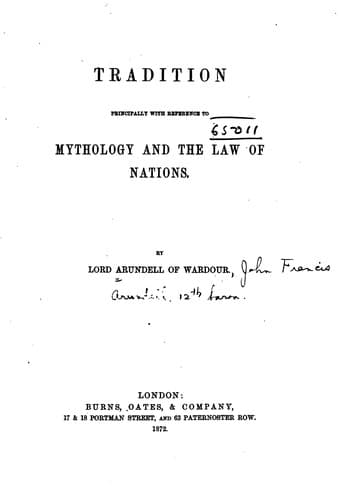
Tradition, Principally with Reference to Mythology and the Law of NationsArundell of Wardour, John Francis Arundell, Baron
Philosophy
Tradition, Principally with Reference to Mythology and the Law of Nations
Arundell of Wardour, John Francis Arundell, Baron
International law; Macdonell, George, 1780-1870; Mythology; Natural law; Tradition (Theology)
Bryant ("Mythology," ii. 219) speaking of Egypt ("the
priests of Ammon who at _particular seasons_ used to carry
in procession a boat," concerning which refer to page 254),
says--"Part of the ceremony in most of the ancient mysteries
consisted in carrying about a kind of ship or boat, which
custom upon due examination will be found to relate to nothing
else but Noah and the Deluge." He adds that the name of "the
navicular shrines was _Baris_, which is very remarkable; for
it is the very name of the mountain, according to Nicolaus
Damascenus, on which the ark of Noah rested, the same as
Ararat in Armenia." Herodotus speaks of "_Baris_" as the
Egyptian name of a ship, l. 2, 96; Eurip. "Iphig. in Aulis,"
v. 297; Æschylus, Persæ, 151; Lycophron, v. 747, refer to
names of ships in connection with Noah. _Sup._, p. 196.
Query--is our word barge a corruption of baris? or perhaps of
_baris_ in connection with "_argus_," also a term for the ark.
(With reference to this etymology _vide_ my remark, p. 116,
and d'Anselme, p. 196, and Bryant, ii. 251.)
But the closest connection is in the nature and order of the ceremonies
on the fourth day at Dahome and among the Mandans. Among the latter,
interrupting the bull-dance on that day, there is an apparition of "the
evil spirit,"[210] graphically described by Mr Catlin (p. 22), and at
Dahome (Burton, ii. 18), there intervenes between the fourth and fifth
days' ceremonies what is called "the evil night" (there are two "evil
nights") which is the night of the horrible massacre. But on this night
also, at the close of the fourth day's ceremonies among the Mandans,
the infliction of tortures (very horrible, but mild in comparison
with the African butchery) commence. Now, I have already ventured the
opinion that these tortures were originally of an expiatory character,
and this gains confirmation by the assurance made to Captain R.
Burton that the victims on "the evil night" were only "criminals"
and prisoners of war, the people of Dahome, on all occasions (_vide
infra_), preferring a vicarious mode of expiation. Captain R. Burton
(ii. 19) says of these massacres:--"The king takes no pleasure in the
tortures and death or in the sight of blood, as will presently appear.
The 2000 killed in one day, _the canoe_[211] paddled in a pool of gore,
and other grisly nursery tales, must be derived from Whydah, where the
slave-traders invented them, probably to deter Englishmen from visiting
the king. It is useless to go over the ground of human sacrifice from
the days of the wild Hindu's Naramadha to the burnings of the Druids,
and to the awful massacres of Peru and Mexico. In Europe the extinction
of the custom _began_ from the time of the polite Augustus," _i.e._
commenced with the advent of our Lord. [_Vide_ a reference to MS. of
Sir J. Acton in Mr Gladstone's address to the University of Edinburgh,
Public-domain text, read in full here on John Shaqi.
Reviews
Reviews
No reviews yet
Be the first to share your thoughts on this work.
Elsewhere in the archive
Join the Discussion
Join the discussion
Sign in to leave a comment or review.
Sign InorCreate an account