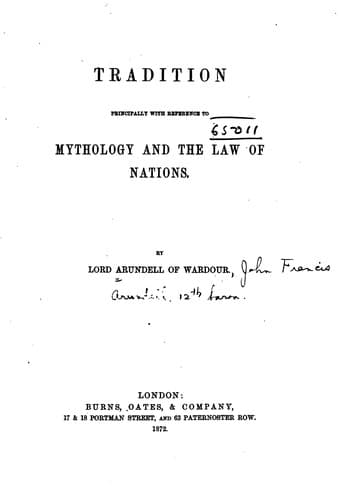
Tradition, Principally with Reference to Mythology and the Law of NationsArundell of Wardour, John Francis Arundell, Baron
Philosophy
Tradition, Principally with Reference to Mythology and the Law of Nations
Arundell of Wardour, John Francis Arundell, Baron
International law; Macdonell, George, 1780-1870; Mythology; Natural law; Tradition (Theology)
1865, from which it would appear that the final extinction was not
until the triumph of Christianity.]
[210] Compare the "Bhain-sasur" or _buffalo_-demon at Usayagiri,
carrying a trident. _Vide_ "The Bhilsa Tope," Major Alex.
Cunningham, 1854.
[211] It is as well to note, however, that the Dahomans have
recently altered their customs. The one Captain Burton
witnessed (ii. 34) was a "mixed custom," and elsewhere
allusion is made to "the new" ceremony.
Without carrying rashness to the excess of disputing the interpretation
of Dahoman words with Captain Burton, I may yet demur to accepting
his explanation of the term "So-sin" (the "So-sin customs") _absolute
et simpliciter_. He says (i. 315), "The Sogan ('So' = horse, 'gan'
captain) opens the customs by taking all the chargers from their owners
and by tying them up, whence the word _So-sin_. The animals must be
redeemed in a few days with a bag of cowries."[212] This is certainly
a very likely definition, and although secondary, is no doubt the
explanation current among the present generation of Dahomans. All
I shall venture to do is to supplement it. But may not the old and
primitive idea still lurk in the name? At i. 242, I perceive Captain
Burton says "so" and "sin" mean _water_,[213] and the compound word
"amma-sin" means "medicine" = "leaf-water," and again at 244 the same
word "Sin" is twice used to signify liquid. If so, in the very name of
the feast we find the word _water_, which links it into connection with
"the Mandan custom" and the festivals of ancient Greece.
[212] Analogies may perhaps be discovered in the representations of
the procession escorting a relic casket on the architraves
of the western gate at Sanchi. (_Vide_ "The Bhilsa Tope," by
Major Alex. Cunningham, p. 227.)
"Street of a city on the left, houses on each side filled
with spectators,... a few horsemen heading a procession,
... immediately outside the gate are four persons bearing
either trophies or some peculiar instruments of office. Then
follows a _led horse_, ... a soldier with a bell-shaped
shield, two fifers, three _drummers_, and two men blowing
_conches_. Next comes the king on an elephant, carrying the
holy relic casket on his head and supporting it with his right
hand. Then follows two peculiarly dressed men on horseback,
perhaps prisoners. They wear a kind of cap (now only known
in Barmawar, on the upper course of the Ravi) and boots or
leggings. The procession is closed by two horsemen (one either
the minister or a member of the royal family) and by an
elephant with two riders."
Public-domain text, read in full here on John Shaqi.
Reviews
Reviews
No reviews yet
Be the first to share your thoughts on this work.
Elsewhere in the archive
Join the Discussion
Join the discussion
Sign in to leave a comment or review.
Sign InorCreate an account