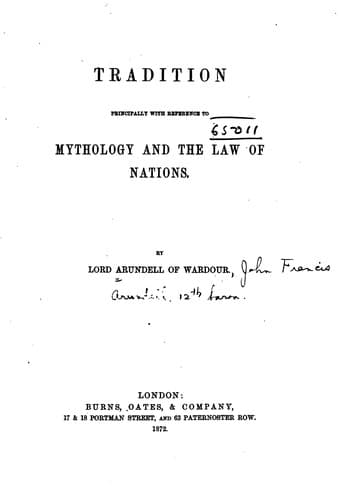
Tradition, Principally with Reference to Mythology and the Law of NationsArundell of Wardour, John Francis Arundell, Baron
Philosophy
Tradition, Principally with Reference to Mythology and the Law of Nations
Arundell of Wardour, John Francis Arundell, Baron
International law; Macdonell, George, 1780-1870; Mythology; Natural law; Tradition (Theology)
[213] The name for _river_ in the Chitral or Little Kashghar
vocabulary (Vigne, "Travels in Kashmir") is river = _sin_;
also in the Dangon, on the Indus, voc. (_id._) river = _sin_;
in the Affghan (Kalproth) the sea = _sin_d. _Sind_hu is the
Sanscrit name for river (Max Müller, "Science of Lang.," 1st
series, 215); and has also its equivalent in ancient Persian.
In Danish, river or lake = _so_; in Icelandic, sjor (sjo);
in Bultistan, touh; German, see; English, sea; in Kashmir,
sar = marse; Icelandic, saus. Compare Rivers Saar, Soane,
Seine, Irish Suir; perhaps also Esk and Usk (Vigne, "Trav. in
Kashmir"). Horse = shtah, in Bultistan. Has not _so_ analogy
with eau, augr (Chittral), _water_? _Sara_ = water in Sanscrit
(Max Müller, "Chips," ii. 47); Sanscrit, vari, more generic
term for water; Latin, mare; Gothic, marie; Slavonic, more;
Irish and Scotch, muir (_id._) Compare Chinese "ma" = horse;
Mongol, "mon" = horse; German, machre; English, _mare_.
Conclusion, either there is the same word for horse and water
in certain languages, which may have occurred in the way of
secondary derivation from these "mysteries," or if _so_ means
water, then "So-sin" may only be a reduplication, as in the
names of some of our rivers--_e.g._ Dwfr-Dwy = water, of Deva
= Dee-river (_Archæol. Journal_, xvii. 98). Bryant ("Myth."
ii. 408) says "The [Greek: hippos], hippus (horse), alluded
to in the early mythology was certainly a _float_ or _ship_,
the same as the ceto." There is, moreover, the analogy in the
Latin of _aqua_ and _equus_. Another Sanscrit word for water,
"ap" (Max Müller, Sc. of L., 103) has analogy with the Greek
[Greek: hippos] = horse. It appears (Sc. of L., 2nd series,
p. 36), that the Tahitians have substituted the word "pape"
for "vai" = water; but both words "pape," to _ap_, "vai," to
_vari_, seem to have analogies to Sanscrit as above. Plato
("Cratylus," c. 36, Sc. of L., 1st series, p. 116) mentions
that the name for water was the same in Phrygian and Greek. At
p. 235, 1st series, Mr Max Müller says that Persian Harôya is
the same as Sanscrit Saroya; which latter "is derived from a
root 'sar' or 'sri,' to go, to run; from which 'saras,' water,
'sarit,' river, and 'Sarayu,' the proper name of the river
near Oude."
Here at any rate in the Sanskrit "sar," to run, we may, if
the above conjecture is rejected, start the words "horse" and
"water" from a common root.
Public-domain text, read in full here on John Shaqi.
Reviews
Reviews
No reviews yet
Be the first to share your thoughts on this work.
Elsewhere in the archive
Join the Discussion
Join the discussion
Sign in to leave a comment or review.
Sign InorCreate an account