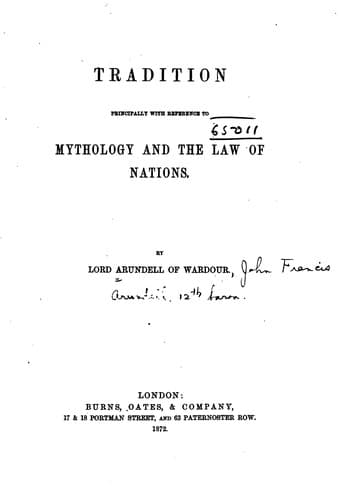
Tradition, Principally with Reference to Mythology and the Law of NationsArundell of Wardour, John Francis Arundell, Baron
Philosophy
Tradition, Principally with Reference to Mythology and the Law of Nations
Arundell of Wardour, John Francis Arundell, Baron
International law; Macdonell, George, 1780-1870; Mythology; Natural law; Tradition (Theology)
It may have had connection with the _As_warnedha or horse
sacrifice (Cunningham, p. 363.) Boulanger (i. 109) says,
"That after the winter solstice the ancient inhabitants of
India descended with their king to the banks of the Indus;
they there sacrificed _horses_ and _black bulls_, signs of a
funeral ceremony; they then threw a bushel measure into the
water without their assigning any reason for it." Compare the
throwing the cakes into the gulf at Athens, and the hatchets
into the water at the Mandan custom. Could it be that at the
Dahoman ceremony the horses were redeemed because the wretched
victims were substituted, carrying out the idea of vicarious
sacrifice and expiation?
Sir John Lubbock ("Origin of Civilization," p. 199) says,
speaking of _water_ worship, "The kelpie or spirit of the
_waters assumed_ various forms, those of a man, woman,
_horse_, or _bull_ being the most common." Compare _supra_,
pp. 196, 202, 204, Manou, Bacchus.
Homer (Hom. Il., Heynii, xxi. 130, Lord Derby, 145), says--
"Shall aught avail ye, though to him (the river Scamander)
In sacrifice, the blood of countless _bulls_ you pay,
And living _horses_ in his waters sink;"
and (210) Asteropoeus is called "river-born," because
the son of Pelegon, who "to broadly flowing Axius owed his
birth." Remembering the belief of certain tribes of Indians
(supra, p. 137) that they were "created under the water,"
which I have construed to mean, that they were created on
the other side of the Deluge, so we may take in a similar
sense the traditions of these Homeric heroes that they were
"river-born;" and does the expression, son of Pelegon (compare
"son of Prometheus," _supra_, p. 232), imply more than
that he was the descendant of Phaleg, or, if not in the line
of descent, the descendant of progenitors who had retained the
tradition that Phaleg was so called, "because in his days the
earth was divided"?--Gen. ch. x. 25. Compare ancient Welsh
ballad (Davies' "Mythology of British Druids," p. 100)--
"Truly I was in the ship
With Dylan (Deucalion), son of the sea....
When ... the floods came forth
From heaven to the great deep."
Public-domain text, read in full here on John Shaqi.
Reviews
Reviews
No reviews yet
Be the first to share your thoughts on this work.
Elsewhere in the archive
Join the Discussion
Join the discussion
Sign in to leave a comment or review.
Sign InorCreate an account