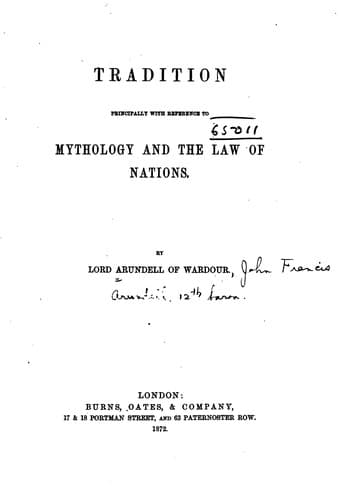
Tradition, Principally with Reference to Mythology and the Law of NationsArundell of Wardour, John Francis Arundell, Baron
Philosophy
Tradition, Principally with Reference to Mythology and the Law of Nations
Arundell of Wardour, John Francis Arundell, Baron
International law; Macdonell, George, 1780-1870; Mythology; Natural law; Tradition (Theology)
Here two or three questions suggest themselves.
If this ceremony is primitive, will not dual
royalty give a clue to the duality we find so
commonly in mythology, assuming the basis of
mythology to be historical? 2d, Is there no clue
in the name, _official_ name, of Dank-li-ke? What
does the reader guess the meaning to be? (p. 58.)
Mr Burton tells us it means, "Dank (the rainbow),
li (stand), and ke (the world)." Is it a forced
paraphrase to construe this to mean--The rainbow
is the sign that the world shall stand?
Upon the point of the precedence of woman, to which the Dahoman
ceremony testifies, but to which it gives no clue, I shall, as it is
so very important in more bearings than one, give at some length the
following scene from Catlin:--
"When 'the evil spirit' enters the camp during the ceremony,
he proceeds to make various attacks, which are defeated by the
intervention of the master of the ceremonies. In several attempts
of this kind the evil spirit was thus defeated, after which he
came wandering back amongst the dancers, apparently much fatigued
and disappointed.... In this distressing dilemma he was approached
by an old matron, who came up slyly behind him, with both hands
full of yellow dirt, which (by reaching around him) she suddenly
dashed in his face, covering him from head to foot, and changing
his colour, as the dirt adhered to the undried bear's grease on his
skin; ... at length _another_ snatched his _wand_ from his hand and
broke it across her knee ... his power was thus gone ... bolting
through the crowd, he made his way to the prairies."--P. 24.
We shall not be surprised to learn, then, that when the "Feast of
the Buffaloes" (distinct from the bull-dance) commences (p. 33),
several old men perambulated the village in various directions, in
the character of criers, with rattles in their hands, proclaiming
that "the _whole government of the Mandans_ was then in the hands of
one woman--she who had disarmed the evil spirit ... that the chiefs
that night were old women; that they had nothing to say; that no one
was allowed to be out of their wigwams excepting the favoured ones
whom 'the governing woman' had invited," &c. Will not this give a
clue to the precedence in Dahome, _probandis probatis_, and is not
the precedence in Dahome thus interpreted, and the interlude above
described evidence of the tradition, that the _woman_ should break the
head of the _serpent_? (Gen. iii. 15). It is of great significance,
and, if so many points of comparison had not occurred, ought to have
been stated at the outset, that at Dahome "the Sin-kwain ("sin,"
water--"kwain," sprinkling), or water-sprinkling custom follows closely
upon the "So-sin or Horse-tie rites."--_Vide_ Burton, ii. 167.
Public-domain text, read in full here on John Shaqi.
Reviews
Reviews
No reviews yet
Be the first to share your thoughts on this work.
Elsewhere in the archive
Join the Discussion
Join the discussion
Sign in to leave a comment or review.
Sign InorCreate an account