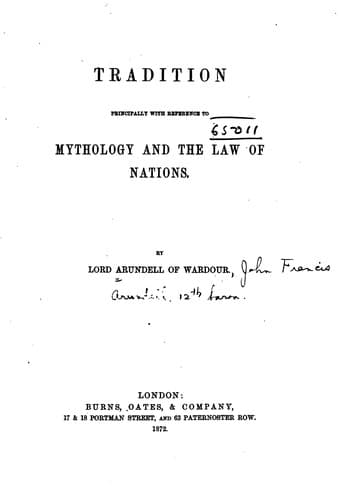
Tradition, Principally with Reference to Mythology and the Law of NationsArundell of Wardour, John Francis Arundell, Baron
Philosophy
Tradition, Principally with Reference to Mythology and the Law of Nations
Arundell of Wardour, John Francis Arundell, Baron
International law; Macdonell, George, 1780-1870; Mythology; Natural law; Tradition (Theology)
Now, if the reader will turn to Boulanger, i. 90, 91, he will find this
identical custom in Persia, Pegu, China, and Japan. But I relinquish
the details, as I fear I shall have exhausted the patience of the few
readers I shall have carried with me to this point; and because the
King of Dahome has a custom perhaps still more demonstrably cognate to
not only the ancient Grecian ceremonies on the shores of the ocean and
on the banks of rivers, but with widely diffused tradition. I shall
here place four writers in juxtaposition, and with this testimony I
shall conclude:--
BOULANGER.
The ancient inhabitants of Italy repaired once a year to the Lake
Cutilia, where they made sacrifices and celebrated secret mysteries
or ceremonies (Dion. Halicarnassus, i. 2).
The pontiffs in ancient Rome also went annually to the banks of the
Tiber, "là ils faisoient des sacrifices _expiatoires_ à Saturne, ce
Dieu chronique," &c. (Dion. Hal. i. 8.)
In the kingdom of Saka in Africa their greatest solemnity was
celebrated on the banks of the rivers; the king himself presides at
it (Hist. Gener. des Voy., iii. 639).
The same custom has been already (_supra_, p. 252) noticed on the
Indus.
In all these cases human sacrifices were offered, or
substitutes.--Boulanger, i. pp. 110-11. Compare _supra_, p. 243,
lines from Dionysius Periegesis.
BURTON.
At Whydat the youngest brother of their triad is Hu, the ocean or
sea. [Compare with Assyrian Hoa, _supra_, p. 194, and Chinese
Yu, p. 68.] "The Hu-no, or ocean priest, is now considered the
highest of all.... At times the king sends as an ocean sacrifice
from Agborne a man carried in a hammock, with the dress, the stool,
and the umbrella of a Caboceer; a canoe takes him out to sea, where
he is thrown to the sharks. The custom for this element is made at
Whydat, in a place near the greater market, and called Hu-kpa-man.
It is a _round_ hut, with thatch and chalked walls: outside is a
heap of bones, whilst _skulls_, carapaces of the _tortoise_, and
similar materials, cumber the _interior_. The priest is a fetish
woman, who _offers water_ and kola nuts to, and expects rum from,
white visitors."--ii. p. 141.
Compare also _supra_, in Preface, extract from Davies' "Celtic
Researches" on the Celtic god Hu.
CATLIN.
Public-domain text, read in full here on John Shaqi.
Reviews
Reviews
No reviews yet
Be the first to share your thoughts on this work.
Elsewhere in the archive
Join the Discussion
Join the discussion
Sign in to leave a comment or review.
Sign InorCreate an account