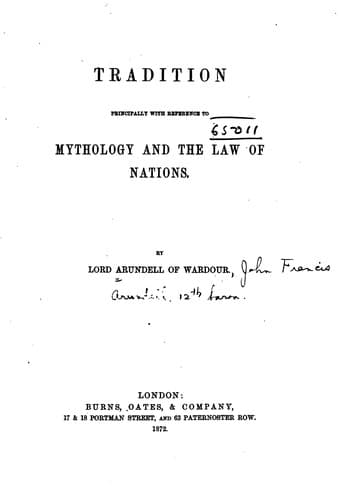
Tradition, Principally with Reference to Mythology and the Law of NationsArundell of Wardour, John Francis Arundell, Baron
Philosophy
Tradition, Principally with Reference to Mythology and the Law of Nations
Arundell of Wardour, John Francis Arundell, Baron
International law; Macdonell, George, 1780-1870; Mythology; Natural law; Tradition (Theology)
[229] _Vide_ Japanese tradition of the Deluge (Bertrand, "Dict.
des Relig.," Gainet, i. 208; also _id._), it is said that
the Japanese commemorate this event in their third annual
festival, which takes place on the fifth day of the fifth
month. Compare with Mandan's, _supra_.
To complete the circle of evidence, as regards the general tradition,
I must add the following extracts from Captain Cook's voyages, i.
110 (London, 1846):--"In the island of Huahieine, thirty-one leagues
from Otaheite N.-W.," Captain Cook came upon an erection, of which
he says--"The general resemblance between this repository and the
ark of the Lord among the Jews is remarkable; but it is still more
remarkable that upon inquiring of a boy what it was called, he said
'Ewharre no Eatua,' it is the house of God. He could, however, give
no account of its signification or use." At p. 111, "Saw (at Uliatea)
several Ewharre-no-Eatua or houses of God, to which carriage poles were
attached as at Huahieine.... From thence we went to a long house not
far distant, where among rolls of cloth and several other things we saw
the _model of a canoe_, about three feet long, to which were tied eight
human jawbones" [eight the number saved in the ark. Compare p. 197 with
Kabiri. Compare with Ogilby (Japan, 177), where the god Canon (Canaan)
is represented with seven heads on _his_ breast, eight with himself, he
having been substituted for Noah as the head of the race.] Captain Cook
adds, however, "We had already learnt that these, like scalps among the
Indians of North America, were trophies of war," and suggests that the
canoe "may be a symbol of invasion." That I must leave to the reader
to decide, but the heads might be "trophies of conquest," and at the
same time memorial heads,--the memorial heads having necessarily been
replaced many times since the custom was first instituted.[230]
[230] Captain Cook, speaking of their dances (p. 115), says,
"Between the dances of the women the men performed a kind of
dramatic interlude, in which there was _dialogue_ as well as
dancing; but we were not sufficiently acquainted with their
language to understand the subject. Some gentlemen saw a much
more regular entertainment of the dramatic kind, which was
divided into _four acts_."
_Vide_ Abbe Gainet, "La Bible sans la Bible," i. 213, quotes
l'Abbe Domenech, who speaks of "the dance of the Deluge among
many nations of the north and west of America." Gainet also
says that there were two distinct traditions of the Deluge in
the east and west groups of the Society Islands (Otaheite).
Public-domain text, read in full here on John Shaqi.
Reviews
Reviews
No reviews yet
Be the first to share your thoughts on this work.
Elsewhere in the archive
Join the Discussion
Join the discussion
Sign in to leave a comment or review.
Sign InorCreate an account