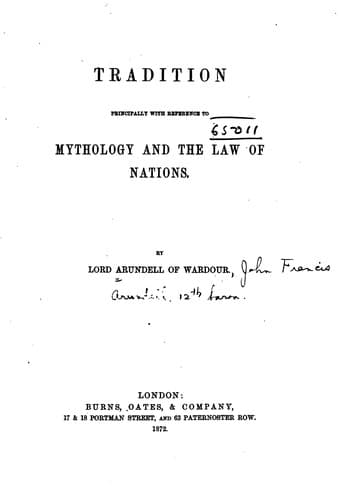
Tradition, Principally with Reference to Mythology and the Law of NationsArundell of Wardour, John Francis Arundell, Baron
Philosophy
Tradition, Principally with Reference to Mythology and the Law of Nations
Arundell of Wardour, John Francis Arundell, Baron
International law; Macdonell, George, 1780-1870; Mythology; Natural law; Tradition (Theology)
[228] Compare p. 448 in "Flint Chips," (E. T. Stevens). "The Omahas
possess a _sacred shell_, which is regarded as an object of
great sanctity by the whole nation. It has been transmitted
from generation to generation, and its origin is unknown. A
skin _lodge is appropriated to it_, and in this lodge a man,
appointed as a guard to the shell, constantly resides. It
is placed upon a stand, and is _never suffered to touch the
earth_. It is concealed from sight by a _number of mats_ made
of strips of skin plaited. The whole forms a large package,
from which _tobacco_" (comp. Stevens' "Flint Chips," p. 315,
and Catlin, _supra_) "and the _roots of trees_" (comp. supra,
p. 155), "and other objects are suspended," &c. &c.
At pp. 477-78 there is perhaps a still more definite tradition of
the Deluge (confused as usual with traditions of the Creation) in
connection with the idol Topan. "Not far from Mettogamma (said the
interpreter) lies an exceeding _high mountain ... the top of which_
stand several temples which may be seen a great distance off at sea.
In these temples the Bonzies worshipped that great God which formerly
created the sun, moon, and stars, but also fifteen lesser deities which
some ages since conversed upon the earth (compare pp. 63, 97.) Then
follows their account of the Creation. "Mankind not only increased
in number but also in wickedness, differing more and more from their
heavenly extract, growing still worse and worse, mocking at thunder,
_rainbows_, and fire; nay, they blasphemed the great God himself
(whom when the interpreter named, he bowed his head to the ground),
whereupon He called His inferior deities about Him, telling them that
He resolved to destroy and ruin all things ... and make a _round_
globe, in which the four elements should be all resolved _into their
former mass_; and chiefly He commanded the idol Topan to make thunder
balls to shoot through the air and fire all the kingdoms with lightning
... so that none were saved except _one man and his family_, that had
entertained and duly worshipped the gods." Of the god Topan it had been
previously said "that some years since he saw the temple of the idol
Topan, whose image stood on a copper altar, cast like clouds, himself
armed as a warrior, a coronet helmet on his head, his hand grasping a
mighty club, and seeming to fly through the sky and moving his club to
occasion thunder. When it thundered, a Bonzi, whose head was adorned
with consecrated leaves [Query, the olive or willow?] which no thunder
could harm," offered _several fishes_." (Comp. 197, 203.) _Vide_ also
p. 94, representation of the fish-god in the person of their "god
Canon" [where we read of their "gods Canon and Camis or Chamis;" if we
were to substitute Canaan and Cham, _quid vetat_?][229]
Public-domain text, read in full here on John Shaqi.
Reviews
Reviews
No reviews yet
Be the first to share your thoughts on this work.
Elsewhere in the archive
Join the Discussion
Join the discussion
Sign in to leave a comment or review.
Sign InorCreate an account