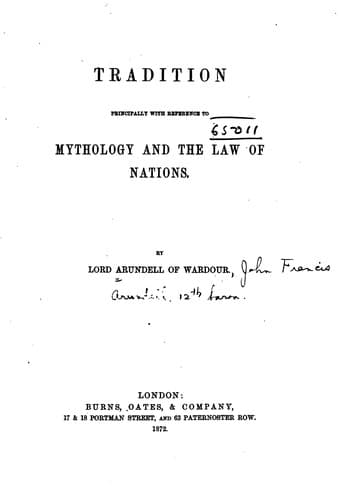
Tradition, Principally with Reference to Mythology and the Law of NationsArundell of Wardour, John Francis Arundell, Baron
Philosophy
Tradition, Principally with Reference to Mythology and the Law of Nations
Arundell of Wardour, John Francis Arundell, Baron
International law; Macdonell, George, 1780-1870; Mythology; Natural law; Tradition (Theology)
"I had seen the Pongol, the touching domestic
festival it is now my chief object to describe.
It had proved by its simple pathos that the
Hindus were akin to the noblest nations of
the world, and that in their antiquity they
were worthy of the honour that has come to
them of being the best and the least altered
representatives of the 'Juventus Mundi,' which
all nations count to have been the golden age."
He contrasts it with the worship in the great
temple at Siringham near Trichinopoly, in which
there "was ample justification for every epithet
employed by Ward, Dubois, or Wilberforce."
"Yet the Pongol declared with equal force in
favour of domestic love and chastity, of simple
thanksgiving and rural contentment.... There is
much reason to suppose that the Pongol is one
of the most complete and interesting of these
remnants of primitive life. That it is primitive
is shown by the fact that the old Vedic deities
are alone worshipped. Indra is the presiding
deity. Agni is the main object of worship. A
further proof of this point is given by the
efforts that have constantly been made by the
Brahmans to corrupt the ritual, and introduce
Pauranic deities. Krishna is always declared
by the Brahmans to be the Pongol god, but the
_tradition itself_ bears witness that the feast
is older than the god. The tale is that when the
great wave of Krishna worship passed over the
Peninsula, the people were so enamoured of him
that they ceased to perform the Pongol rites
to Indra. This made the latter deity _so angry
that he poured down a flood upon the earth_. The
affrighted people ran to Krishna, who seized
the great mountain Govardhanas, wrenched it
from its place, and held it aloft on the tip of
his little finger, like some huge umbrella. The
people then ran beneath with their flocks and
were saved.... The occasion of the festival is
also primitive, for the Pongol is another feast
of ingathering, the centre of Hebrew festivals,
as this is of those of Southern India.... The
Pongol is remarkable, as will be seen, for the
strange combination of pastoral, hunting, and
agricultural life. There are 'harvest homes' in
almost every nation, but I do not know of any
other example of the combination. The _great_
days of the feast are two--one of these devoted
to the new crops, the other to the cattle alone
... while the feast winds up with a grand hunt,
first of the cattle themselves and next of a
hare." Compare ch. vii.; compare Patagonian.
Public-domain text, read in full here on John Shaqi.
Reviews
Reviews
No reviews yet
Be the first to share your thoughts on this work.
Elsewhere in the archive
Join the Discussion
Join the discussion
Sign in to leave a comment or review.
Sign InorCreate an account