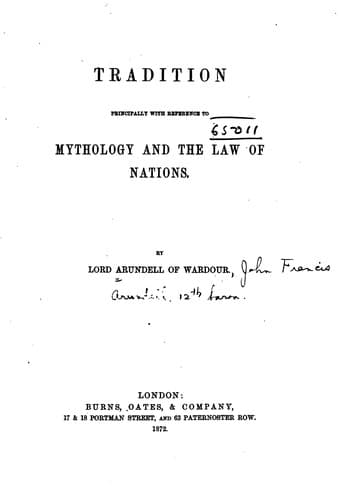
Tradition, Principally with Reference to Mythology and the Law of NationsArundell of Wardour, John Francis Arundell, Baron
Philosophy
Tradition, Principally with Reference to Mythology and the Law of Nations
Arundell of Wardour, John Francis Arundell, Baron
International law; Macdonell, George, 1780-1870; Mythology; Natural law; Tradition (Theology)
"Long before the commencement of the feast an
unwonted activity pervades native society. The
Pongol is _the_ social festival of the year,
and must be celebrated with due honour, else
an ineffaceable stain will rest on the family
name. It is the Christmas and Whitsuntide of
England made into one.... So soon as the _rains
have finished_, and this may be expected by
about the first week in December, the carpenter,
the builder, and the artists are in full work
repairing the houses.... The sides of the road
in the bazaar are heaped with 'chatties' of
all sizes and shapes. Presents are bought for
children. Distant relatives have no fields of
their own from which to get their rice, so a
sack of the new grain from the ancestral acres
goes off to each. To this is added a pot of
ghee, a set of brass pots, or perhaps a jewel;
that the Pongol may not lack wherewith to make
it joyful." Creditors and debtors are often
brought then to a compromise, or the process is
postponed "till after Pongol."
"All must be ready by the early part of January,
when, according to the Hindu astrologers, the
sun enters the tropic of Capricorn. The feast
hangs upon this, and it will be seen that the
most interesting event of the celebration must
exactly coincide with the passage of the sun.
The festival commences on the previous day,
and lasts for seven days, of which the second
marks the sun's passage, and is called Mahâ (or
great) Pongol, ... the next day is Bhôgi Pongol,
or Pongol of rejoicing, equally well known by
the name of Indra, ... bonfires and torches are
illuminated (compare Boulanger, lib. i. ch.
ii.) The feast is now begun, and all turn from
the fire, as it is extinguished by the rising
sun, to the _bath_, with which every religious
rite must commence. No image is used during
the whole course of the celebration, except
that of Ganesa.... Indra is represented on
ordinary occasions as _a white man_ sitting on
an elephant. In his left hand is a bow (compare
ch. xv.), and in his right a thunderbolt,
while his body is studded with a thousand eyes.
[Query, a reference to the peacock? Compare ch.
xv.] Agni has also his special image, that
of a stout man, red and hairy as Esau, riding
on a goat [compare Bacchus, p. 214]. Sûrya
is also a red man, sitting on a water lily.
He has four arms and three eyes. But none of
these (deities) are known at Pongol any more
than they were at the time when the hymns of
the Rig Veda were composed.... The gifts are
laid out on trays,--a vase of sugar, or perhaps
an idol, _peacock_ or elephant, round which
will be grouped smaller works in sugar for the
children.... One thing may not be forgotten,
that is a lime [compare 'gourd,' p. 256]. This
must be _as large_ as money can buy, and then
be carefully encased in gold leaf till it looks
like one of the golden apples of antiquity. The
next day is Mahâ (or great) Pongol. It is often
called Sûrya Pongol. At noon the sun will cross
Public-domain text, read in full here on John Shaqi.
Reviews
Reviews
No reviews yet
Be the first to share your thoughts on this work.
Elsewhere in the archive
Join the Discussion
Join the discussion
Sign in to leave a comment or review.
Sign InorCreate an account