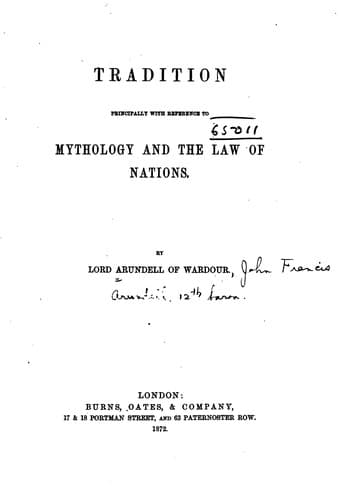
Tradition, Principally with Reference to Mythology and the Law of NationsArundell of Wardour, John Francis Arundell, Baron
Philosophy
Tradition, Principally with Reference to Mythology and the Law of Nations
Arundell of Wardour, John Francis Arundell, Baron
International law; Macdonell, George, 1780-1870; Mythology; Natural law; Tradition (Theology)
"The third day of the feast is Mâttu Pongol, or
the Pongol _of the cattle_. It commences with
a general _wash_. They betake themselves to
the nearest _sacred_ tank, driving or dragging
with them the whole bovine possessions of
the village. They are then driven home, and
adornment commences; the horns are carefully
painted _red_, _blue_, _green_, _or yellow_,--if
the owner be rich, gold leaf is employed,--heavy
garlands of flowers placed on the horns.
Meanwhile the women have prepared another new
chatty, filling it with water, steeping within
saffron, cotton seeds, and mangora leaves. The
master of the ceremonial, usually the head of
the house, comes for it, and places himself at
the head of a procession of all the men--the
women may not see the rite we now describe. In
solemn silence they march round each animal four
times, while the first man sprinkles the bitter
water upon it and the ground as often as they
pass the four cardinal points of the compass....
This done, the women and children are again
admitted. The patient cattle are led out one by
one to receive their final adornment.... Then,
at a given signal, every rope is untied, every
tom-tom, pipe, and guitar is banged or blown to
the extreme of its endurance, and in an instant
the herd, hitherto so patient, is careering down
the street in an extremity of terror.... Any one
may possess himself of whatever is carried by
the cattle. No little skill and a vast amount of
courage are shown by the 'timid' Hindoos in this
dangerous and exciting pell-mell. The next day
is Kanen Pongol, or Pongol of the calves.
"On the evening of this day we find the only
token of corruption in the ceremonial." ... Then
follows a dance, just as is described by Catlin
as _closing_ the Mandan ceremonial, in which
very similar scenes occur.
Before adverting to the points of contrast
between the Pongol and the Mandan and Dahoman
ceremonies, I will give an extract from a
book recently published, giving an account of
a country hitherto unexplored--viz. Northern
Patagonia. Traces I think will be recognised of
the same primitive custom, though with evidences
of corruption.
"Three Years Slavery among the Patagonians," by
Guinnard (Bentley, 1871), p. 269.[233]
Public-domain text, read in full here on John Shaqi.
Reviews
Reviews
No reviews yet
Be the first to share your thoughts on this work.
Elsewhere in the archive
Join the Discussion
Join the discussion
Sign in to leave a comment or review.
Sign InorCreate an account